myLOOT, a Play-to-Earn gaming app, integrated Octopus Community's React Native SDK to move its social layer from Discord into the app itself. Community users now launch 4.4x more app sessions and spend 6x more time in-app than non-community users.
4.4x more app sessions for community users
6x more time spent in-app for community users
1.7x D7 retention and 1.6x D30 retention for community users
110x more visitors than the Discord channel
11.7k+ contributions per month from the community
25.8% of myLOOT's daily active users visit the in-app community
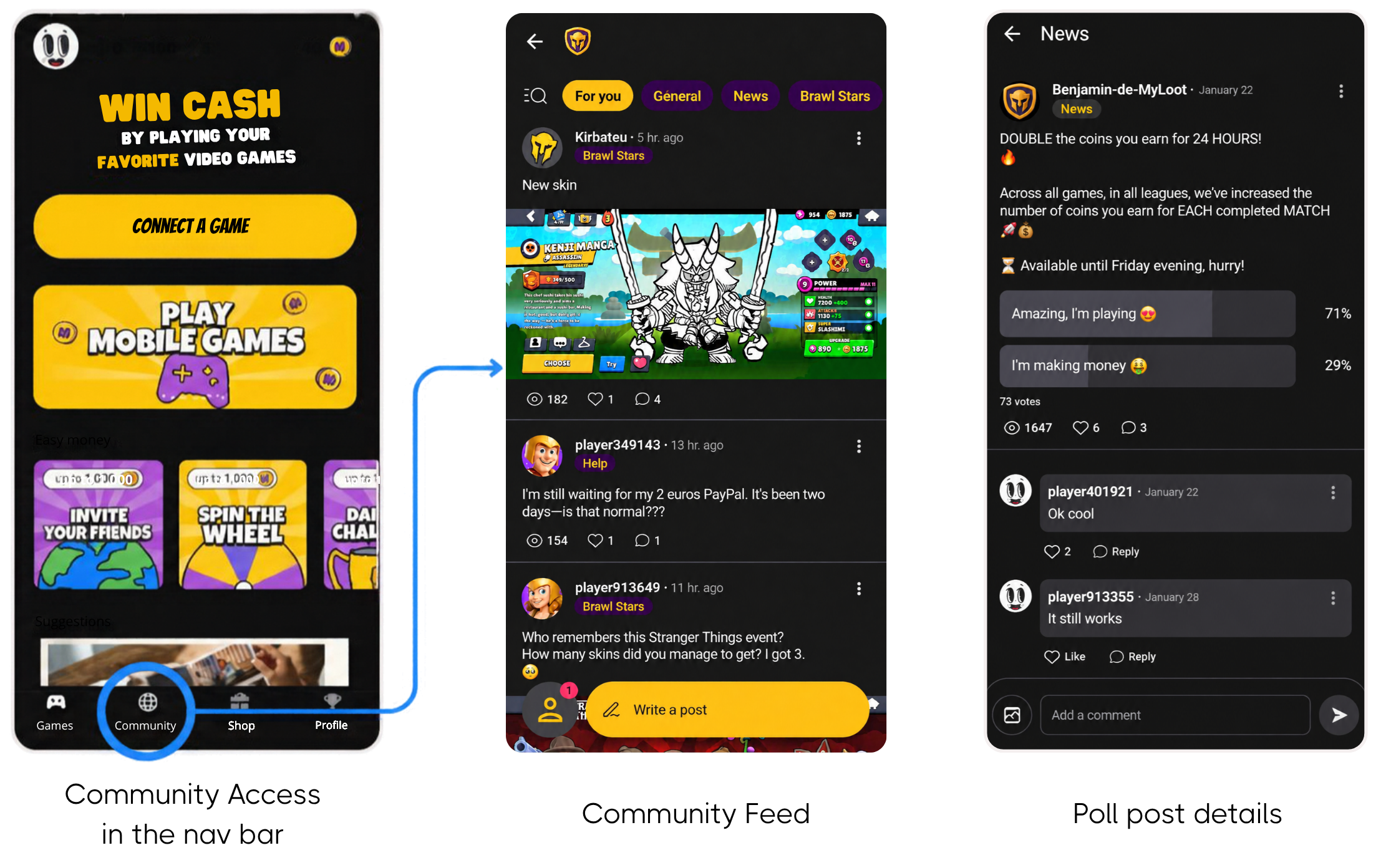
myLOOT is a free mobile gaming app that rewards players for their performance in competitive games. Available on iOS and Android, the app lets gamers earn coins and real prizes by playing titles like Valorant, Clash Royale, Brawl Stars, and Chess. Since launching in 2023, myLOOT has accumulated over 500,000 downloads, with a core base of engaged gamers who play and compete daily.
Before Octopus Community, myLOOT’s most engaged users already had a social home: Discord. Members gathered there to discuss strategies, compare scores, and find players to challenge. The community was alive. It just wasn’t inside the app. Members had to leave myLOOT to chat. The social loop, the part that keeps people coming back, was happening on someone else’s platform.
For the myLOOT team, this was a clear problem. They had built a product around gaming performance, but the social experience that drives long-term retention was being captured by a third-party app.

Building a full social layer from scratch was off the table. The engineering team was small, and the product roadmap was already dense. Real-time feeds, threaded discussions, moderation, backend: the complexity would have taken months.
Octopus Community offered a different path: a production-ready React Native SDK that could be embedded directly into myLOOT, fully branded with myLOOT’s visual identity, with SSO so users wouldn’t need to create a separate account. Players would access the community with the credentials they already had.
The integration was handled by a developer who had recently joined the myLOOT team and was not yet fully familiar with the codebase. Despite this, both iOS and Android were fully integrated in a single day.

A post-game social loop that stays in the app
After finishing a Valorant session or a Clash Royale match, players can immediately jump into the community to discuss their performance, comment on others’ results, or find their next opponent, without switching apps.
Game-specific channels that connect the right players
By organizing the community into topic-based channels (Valorant, Brawl Stars, Chess, Help), myLOOT gave its players dedicated spaces to discuss the specific games they care about.
Community-driven retention at scale
Community users are myLOOT’s highest-value users. The in-app community acts as a natural retention layer: players who socialize return more often, and open the app more.
AI-powered moderation without a dedicated team
With Octopus Community’s AI moderation features (automatic ban for toxic content and AI tagging for support messages), the myLOOT team manages the community efficiently without manually reviewing every post.
A foundation for future social features
myLOOT is already planning the next phase: AI-powered automatic answers to common questions, video content, and more. The Octopus SDK gives the team a social infrastructure to iterate on without rebuilding from scratch.

myLOOT didn't need to build a community from scratch. It needed to move the one it already had to where players spend their time. Once the conversation moved inside the app, it stopped competing with gameplay and started feeding it: community users come back more often, stay longer, and retain better.
For gaming apps with an active Discord, the lesson is simple. Discord reaches your most dedicated fans. An in-app community reaches every player, every session.


How myLOOT moved its social layer from Discord into the app, and now sees community users launch 4.4x more app sessions with Octopus Community.
Octopus Community is embedded directly into the myLOOT app via a React Native SDK. Players access the community through a dedicated section of the app and log in automatically using their existing myLOOT credentials. The community is organized into topic-based channels matching myLOOT’s supported games.
The full technical integration for both iOS and Android took one day, even for a developer who had just joined the team and was still getting familiar with the codebase. Clear documentation and fast support from the Octopus team made this possible.
Nearly half. Since the community launched in November 2025, 45% of myLOOT's monthly active users visit it each month. Because it lives inside the app, players don't have to seek it out or join a separate platform. It's right there after every game.
myLOOT had an active Discord server but it operated outside the app. By embedding the community directly into the app with Octopus Community, myLOOT brought the social layer inside the product, where it directly drives engagement, retention, and session frequency.
Absolutely, and myLOOT is the proof. Discord captures your most dedicated fans: they sought it out, joined voluntarily, and are already invested. But they represent a small fraction of your user base. The vast majority of players will never open Discord. By embedding a community directly into the app, myLOOT made social interaction accessible to 100% of its users. 25.8% of myLOOT's daily active users now visit the in-app community. That's an audience Discord could never have reached.
Gamers are inherently social. They compare scores, debate strategies, look for opponents, and celebrate wins. That social energy already exists; the question is where it happens. Before Octopus Community, it happened on Discord, Reddit, or group chats, all outside the app. Bringing that conversation in-app means that every social interaction reinforces the habit of opening myLOOT, rather than a competitor’s platform. The result is a virtuous loop: players open the app to play, then stay to talk, and come back the next day to do both.
Book 30 minutes with us. We’ll show you the SDK running inside an app like yours.
Ready within 24h — we'll send it straight to your inbox.
Sandbox environment, no credit card required.
Your demo API key will be in your inbox
at within 24h.
In the meantime, explore the
developer docs →