Airport Simulator, Playrion Game Studio's free-to-play airport management game for iOS and Android, integrated Octopus Community's native Unity SDK in July 2026. Within six weeks, 20% of its tracked players had joined the in-app community, available in eleven languages, and community members were opening the app up to 7.6x more often than everyone else.
Such exceptional results in so little time show that community can be one of the highest-leverage investments a mobile game can make.
+4.3% in-app purchases, +8% ads viewed and +6.8% game currency spent, for the Octopus-access cohort in A/B test
+10.3% week-1 retention for that same A/B test cohort
50x faster growth than Discord: matched Playrion's 3-year, 15,000-member Discord server in under a month
7.6x more app sessions for community members vs. non-community players
74.4% of visitors return more than once, and 14.6% have visited 8 times or more
20% of the player base joined in the first weeks of launch
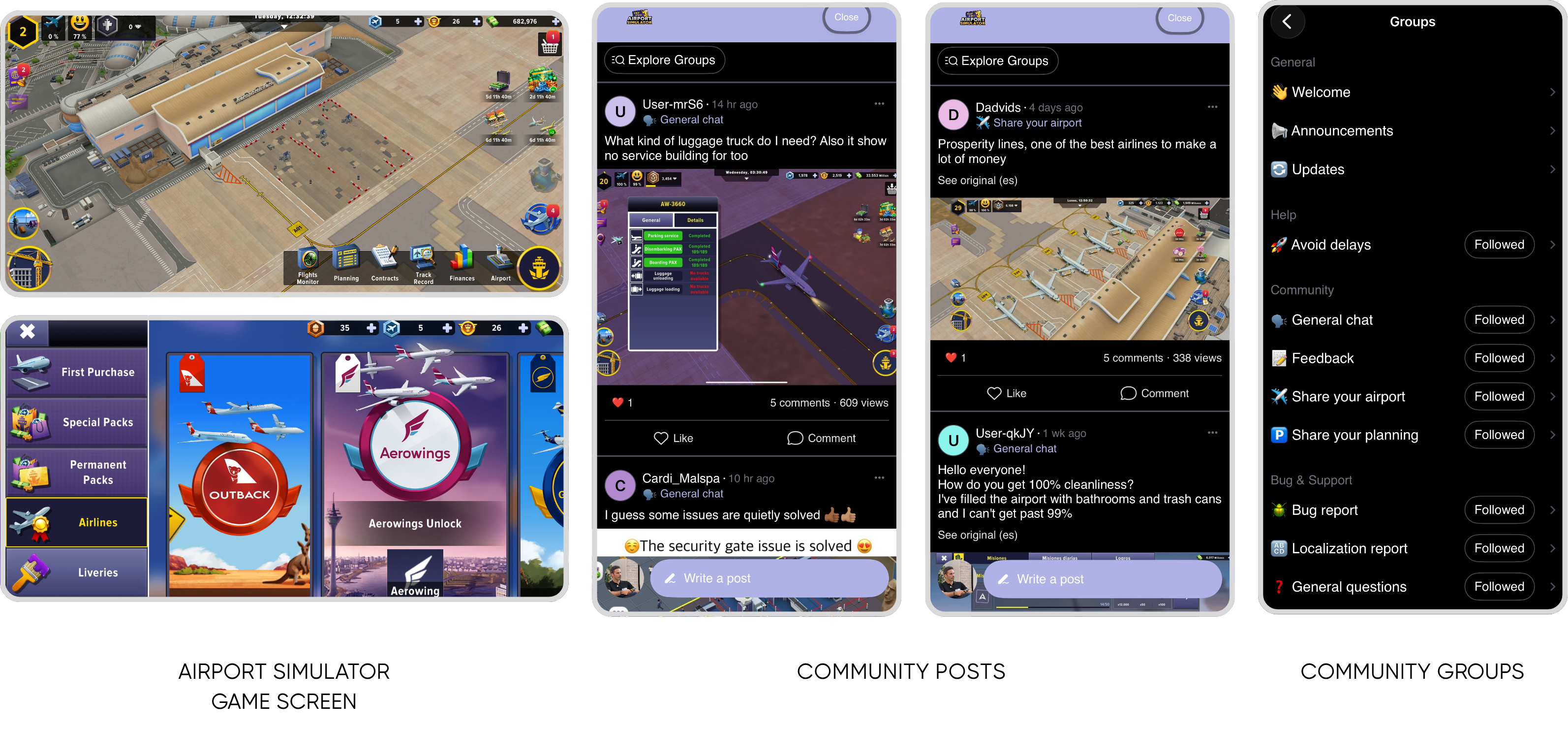
Airport Simulator is Playrion Game Studio's free-to-play airport management game, available on iOS and Android. Based in Paris, Playrion designs mobile games built around aviation. Airport Simulator has built a large, fast-growing player base, localized in eleven languages (French, English, Italian, Portuguese, Dutch, Spanish, German, Arabic, Korean, Malay and Indonesian) across a genuinely global audience.
Airport management games are built around long, solitary sessions: players spend weeks quietly optimizing their own airport, with no natural way to compare notes with anyone else playing the same game. Playrion did have a place for that, its own Discord server, but it meant leaving the game and creating a separate account just to talk about a game players were already playing. What Playrion lacked was a way for its most invested players to show off their work and swap tips without leaving the app, and a direct line to what those players wanted next.

Airport Simulator integrated Octopus Community's native Unity SDK in July 2026, letting players join with their existing in-game login. Integration took Playrion's team a couple of days, with the trickiest part being token authentication rather than the SDK itself. The community only unlocks once a player reaches level 5, so brand-new players aren't dropped into it before they're ready. It also launched already covering all eleven supported languages, with:

Adoption climbed steadily, then kept climbing as word spread inside the game itself. Six weeks in, 20% of players who'd unlocked the community had joined, a conversion rate many communities don't reach until a full quarter after launch.
Players mostly use the community to help each other: asking how to unlock a route or fix a layout bottleneck, then getting an answer from someone who's already solved it. That saves players a support ticket, and shows Playrion exactly where they get stuck, clearly enough that the studio has already used it to improve the game.
Playrion's Discord server took about three years to reach 15,000 members. Airport Simulator's in-app community hit that same number in under a month, roughly 50x faster. No separate sign-up, no switching apps.
74.4% of members have visited more than once, and 14.6%, have visited 8 times or more, a sign that the community holds players past a single novelty visit.
Community members open the app 7.6x more often than non-community players, one of the highest session multipliers Octopus has recorded across any client, gaming or otherwise.

Six weeks after launch, Airport Simulator's community became a daily habit for 20% of players, who open the app 7.6x more often than everyone else.
Playrion's own A/B test results revealed: +10.5% Day-1 retention and +10.3% Week-1 retention, plus monetization gains on both ends of the player base. Non-paying players view more ads, and paying players spend more on in-app purchases and game currency, all within the same six weeks.
This further proves that community isn't just an engagement play; it's also a revenue driver.


Airport Simulator lifted monetization 7.4% and sessions 7.6x within six weeks of launching its in-app community with Octopus Community.
Using Octopus Community's native Unity SDK and players' existing in-game login, Airport Simulator's community went live already supporting all eleven of the app's languages, with AI-powered moderation covering every one of them from day one, rather than rolling languages out one at a time.
For a management sim where retention depends on players returning to tend their airport, a 7.6x session lift signals that the community is reinforcing the core play loop, not competing with it. That lift shows up in revenue immediately too: more sessions means more ad views.
74.4% of everyone who has visited Airport Simulator's community has come back more than once, and 14.6% have visited 8 times or more, a growing base of repeat visitors rather than a one-time spike of curiosity.
Playrion's own 90/10 A/B test, holding 10% of players out without Octopus access, found the Octopus cohort spent +4.3% more on in-app purchases, viewed +8% more ads, and used +6.8% more game currency, all within the community's first six weeks. The engagement lift shows up in Airport Simulator's business metrics, not just its session counts.
Playrion's own Discord server, live since 2022, took roughly three years to reach 15,000 members, a number Airport Simulator's in-app community matched in under a month, about 50x faster, without asking players to leave the app or create a separate account.
Book 30 minutes with us. We’ll show you the SDK running inside an app like yours.
Ready within 24h — we'll send it straight to your inbox.
Sandbox environment, no credit card required.
Your demo API key will be in your inbox
at within 24h.
In the meantime, explore the
developer docs →