TL;DR
Automated content moderation uses software to detect possible policy violations and apply or recommend an action. It is broader than AI moderation: keyword rules, spam controls, behavioral signals, known-content matching, user reports, routing and audit logs can all be part of the system. We recommend automating clear, reversible decisions, escalating ambiguous or high-consequence cases, and measuring exposure, errors, review time and overturned actions. A classifier is useful. A complete moderation operation is what keeps a community safe.
Moderation is a decision system. The technology sees signals; policy defines what those signals mean; operations decide what happens next.
Teams get into trouble when they buy a detection tool and assume the rest will organize itself. Someone still needs to write the rules, connect risk levels to actions, review edge cases, respond to reports, handle appeals and update the system as language and behavior change.
What is automated content moderation?
Automated content moderation is the use of software to evaluate user-generated content against community rules and take or recommend an enforcement action. The action may allow publication, block content, hide it, reduce its visibility, flag it, restrict an account or send the case to a reviewer.
Automation can happen before or after publication. It can rely on explicit rules, databases, metadata, behavioral patterns, machine-learning classifiers or several layers together. Ofcom's research on content moderation describes policy enforcement as a combination of technical systems, personnel and processes. That is the right frame: automation is part of an operation, not a policy in a box.
Automated moderation is broader than AI moderation
AI moderation uses models to interpret content, classify risk or estimate whether a policy applies. Automated moderation includes AI, but it also includes deterministic controls and workflow actions.
| Automation layer | Best use | Typical limitation | Possible action |
|---|---|---|---|
| Keyword and pattern rules | Known terms, links, referral codes and repeated formats | Weak understanding of context | Block, hide or route |
| Rate and behavior controls | Spam bursts, repeated posting and suspicious account activity | Can catch legitimate high activity | Slow, restrict or review |
| Known-content matching | Exact or near-exact prohibited material | Cannot detect genuinely new content | Prevent publication |
| AI classification | Contextual categories such as harassment or toxicity | Uncertainty, bias and missing conversation context | Score, hide or escalate |
| Member reports | Problems users recognize after publication | Can be slow, coordinated or abusive | Reopen and prioritize |
| Workflow automation | Queuing, notifications, audit and escalation | Depends on good policy and ownership | Assign, record and notify |
The layers should cover one another's weaknesses. A blocked-domain rule can make a confident decision quickly. An AI model can interpret a less direct comment. A member report can surface context neither system saw. A reviewer handles the case where the consequence or ambiguity is too high for automatic action.
How does automated content moderation work?
A practical workflow has six stages.
- Policy defines the decision. The community states what is prohibited, restricted or reviewable, with severity levels and examples.
- Content and behavior are screened. Rules, models and account signals evaluate the post, comment, image, profile or action.
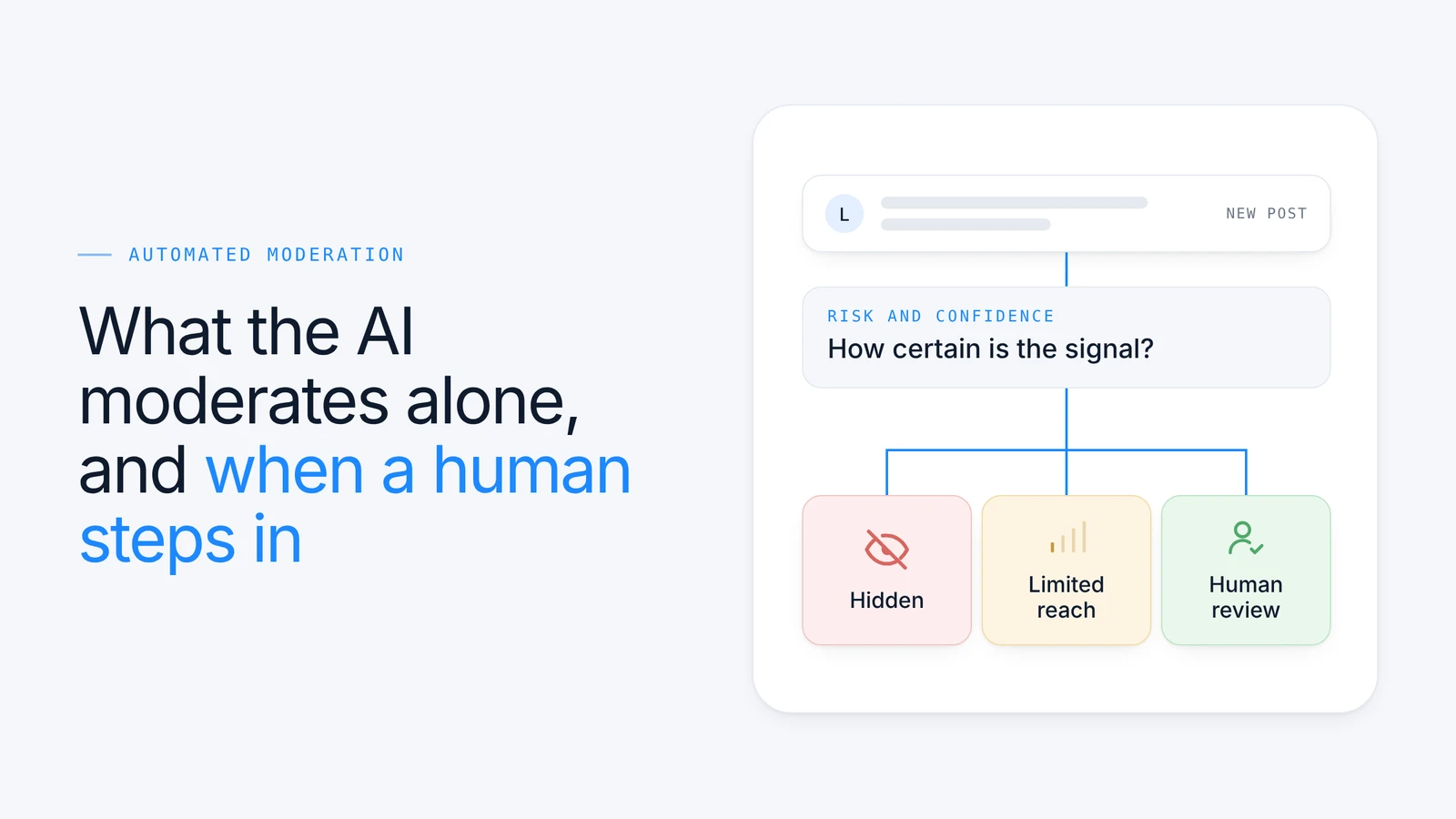
- The system assigns risk and confidence. A match or score indicates how strongly the evidence supports a policy category.
- Policy converts the signal into an action. A clear violation may be blocked; uncertain content may publish with limited visibility or enter review.
- Reports and review catch what automation misses. Members and moderators add context, correct mistakes and handle appeals.
- Outcomes improve the system. Overturned decisions, new abuse patterns and reviewer feedback change rules, thresholds and guidance.
The third and fourth stages must remain separate. A high probability of belonging to a category does not decide how severe the case is or which action is proportionate. Policy makes that choice.
Automate according to confidence and consequence
We use two questions: how certain is the signal, and what happens if the decision is wrong?
High-confidence, low-consequence cases are the best candidates for automatic action. Obvious spam or a prohibited referral link can often be blocked immediately. A disputed threat, sensitive allegation or possible self-harm signal may need rapid human attention even when model confidence is lower.
False positives and false negatives have different costs. Removing acceptable speech can damage trust and participation. Missing harmful content can expose users and the brand. Thresholds should therefore vary by policy and action rather than relying on one global score.
Reversibility matters too. Queuing an item is easier to correct than permanently banning an account. The more consequential the action, the stronger the evidence and review path should be.
Human review is a designed layer
Human review is not what happens when automation fails. It is the control layer for ambiguity, impact and system improvement.
Reviewers handle sarcasm, local context, quoted abuse, cultural nuance, conflicting rules, appeals and new behavior. They also identify patterns that should become a rule and rules that have started producing bad outcomes.
A managed moderation service and moderation software are not the same purchase. Software can provide detection, queues and actions. A managed service also supplies the people, escalation process, calibration and daily operational ownership. Product teams should ask who is watching the edge cases at 2 a.m., not only which model powers the dashboard.
“I would automate link blocking without hesitation. On a marketplace like Opla, a link to a competitor has no place, and a wrongly blocked link costs a user a few seconds. A member describing a mental health crisis in a health app is the opposite case. Removing it can hurt someone who needed support, leaving it unchecked can hurt others. That post waits for a human.”
Grégoire Mercier, Co-founder and CEO, Octopus Community
What we automate at Octopus
Our moderation system uses five layers: keyword pre-filtering, AI contextual scoring, community reports, human review and optional client dashboard control. Every piece of content is checked by AI before it goes live. Default policies cover hate speech, spam, harassment and illegal content, and clients can add rules for their own product and audience.
The action is configurable by policy. Clear violations can be hidden, banned or shadowbanned automatically. Sensitive edge cases go to our own human moderation team, which also handles manual review, rule calibration and escalation. AI moderation is included with every SDK and the core feed; it is not an add-on that leaves the client to staff a queue.
This operating model protects the product position we recommend. A mobile team should not need to build a community and then quietly inherit a moderation department.
Custom rules make automation useful to a real product
Universal safety categories are only the baseline. A finance app may prohibit referral codes and loan promotions. A marketplace may block competitor links. A career community may need to prevent CV images containing personal information. The same phrase can also carry different meaning in a gaming group and a recovery community.
Hellowork combined AI moderation, custom rules and sentiment analysis for a community discussing job loss, salaries and employer experiences. Its workflow included controls for personal information in CV images and escalation for negative brand or support signals. Across that combined workflow, 18.5% of messages were flagged or moderated, with no dedicated in-house moderation team.
That 18.5% is not an accuracy score and should not be reused as a benchmark. It shows why product-specific rules and routing belong beside the classifier.
Measure the moderation outcome, not the amount removed
A rising removal count can mean detection improved, abuse increased or a rule became too broad. It cannot establish success by itself.
We recommend measuring:
- prevalence or exposure to violating content;
- precision and false-positive rate by policy;
- recall or known miss rate where it can be estimated;
- time from submission or report to action;
- queue size and age by severity;
- appeal and overturn rate;
- repeat violations and account-level patterns;
- reviewer disagreement and calibration changes.
The NIST AI Risk Management Framework recommends documented human oversight, testing before deployment, production monitoring and feedback mechanisms. Applied to moderation, that means reviewing errors by category and consequence, not celebrating one blended “accuracy” number.
Build the workflow before scaling the automation
Start with policy, severity and ownership. Decide which cases can be acted on automatically, which should be held or limited, who reviews uncertainty and how a member can report or appeal. Then choose detection methods and thresholds for that workflow.
Octopus supplies the rules, AI layer, reports, actions and human operations as part of the in-app community system. Explore zero-effort moderation for mobile teams or book a demo to review the workflow for your use case.
Frequently asked questions
Can content moderation be fully automated?
Some clear, repeatable decisions can be automated. Ambiguous language, severe allegations, appeals, local context and high-consequence account actions still need human judgment. The right goal is controlled automation, not the removal of people from every decision.
What is the difference between automated moderation and AI moderation?
Automated moderation is the broader system. It can include keyword rules, rate limits, known-content matching, reports, routing and enforcement actions. AI moderation is one layer that uses machine-learning models to classify content or estimate risk.
Should moderation happen before or after publication?
Use pre-publication checks when exposure creates meaningful risk and the decision can be made quickly. Post-publication detection and reporting remain necessary because context changes, users spot missed problems and some patterns emerge across several actions.
Which moderation actions are safest to automate?
Automate high-confidence, well-defined and reversible actions first, such as obvious spam blocking or queue prioritization. Apply stronger review requirements to permanent bans, sensitive allegations and cases where an error could seriously affect a user.
Why do automated moderation systems need user reports?
Reports add context after publication and surface content or behavior the system missed. They should feed a prioritized review workflow and be protected against coordinated or abusive reporting.
How should moderation automation be measured?
Measure exposure to violating content, false positives, known misses, time to action, queue age, appeals, overturned actions and repeat violations by policy. Removal volume alone cannot show whether the system is accurate or proportionate.