
TL;DR
Mobile app engagement is evidence that users are receiving value now; retention shows that the value is strong enough to bring them back. We recommend managing the two as one lifecycle system: define the behavior that represents value, measure whether it predicts return, diagnose the point where the loop breaks, and test the product change against a control group when retention is the business case. Community can strengthen that system because users create fresh reasons for one another to return, but it still needs deliberate discovery, participation, notifications, moderation, and measurement.
More activity is not the same as a healthier app. A notification can produce a session. A promotion can produce a spike. Neither proves that users found enough value to come back next week.
We treat mobile app engagement and retention as two views of the same system. Engagement shows whether users are reaching valuable moments inside the product. Retention shows whether those moments are repeatable. If a team optimizes one without the other, it can become very efficient at moving a metric that does not matter.
What is mobile app engagement?
Mobile app engagement describes how often users interact with an app and whether those interactions deliver value. The right measure depends on the product. A banking app may track a completed budget review or a contribution to a savings goal. A fitness app may track a logged workout, a completed program week, or a maintained streak. A news app may care about an article read to the end or a poll answered, while a retail app may look at a saved product, a customer review, or a repeat purchase. In every case, the useful signal is an action that delivers value to the user.
Session count and time spent are helpful context, but they are rarely the final answer. Google Analytics defines an engaged session using time, key events, or multiple page or screen views. That creates a consistent reporting rule. It does not decide what value means in your product; the product team must do that.
Useful engagement metrics can include active users, feature adoption, session frequency, contribution, repeat usage, and completion of a core action. DAU, WAU, MAU, and DAU/MAU stickiness can describe frequency, but none of them proves that the activity created value.
We recommend choosing a small number of value events and testing whether they predict future use. If people who complete an event do not retain better than a comparable group, the event may be busywork dressed as engagement.
How engagement and retention work together
Retention is the proportion of users who return in a defined period after a starting event such as installation, registration, subscription, or first use. Day 1, Day 7, and Day 30 retention are common checkpoints, but the interval must match the product's natural rhythm. Daily retention suits a habit used every day; monthly retention may be more honest for a product built around pay cycles, trips, or occasional projects.
The useful question is not simply, “What is our retention rate?” It is, “Which repeatable experience gives this user a credible reason to return?” That question connects product behavior to business impact.
Activation creates the first proof of value
Activation is the point at which a new user experiences the product's core benefit. If users leave before that moment, a re-engagement campaign is treating the symptom. We would first remove onboarding friction, shorten the path to value, and make the next action obvious.
Recurring value turns a first success into a habit
A useful first session is not enough. The product needs a reason for the experience to change or renew. New progress, updated information, another person's response, a fresh challenge, or a developing conversation can all create recurring value. Without it, “come back” is only a request from the company.
Return signals complete the loop
Notifications, badges, email, and in-product prompts work when they point to value that already exists. A reply to the user's post is a reason to return. A generic reminder that the app still exists is usually not. The phone already has plenty of apps clearing their throats.
Measure the lifecycle, not a pile of disconnected metrics
We use three layers of measurement. First, behavioral metrics show whether users reach the valuable action: activation rate, meaningful actions per active user, contribution rate, repeat participation, and time to first response. Second, retention metrics show whether users return: cohort retention, churn, returning-user rate, and retention by acquisition or product cohort. Third, guardrail metrics reveal whether the improvement came at an unacceptable cost: notification opt-outs, reports, blocks, crashes, support contacts, or subscription cancellations.
Do not mix cohorts or comparison methods. Retention among community participants answers a different question from retention across everyone offered the feature. Participants often begin with higher intent. A controlled rollout gives stronger evidence because it compares similar users with and without access.
Use external benchmarks as context, not targets
Adjust's Mobile App Trends 2026 report shows why category context matters. In 2025, global finance app sessions rose 21%, finance session length increased 8% to 7.18 minutes, e-commerce sessions grew 5%, and casual-game session length increased 15% to 25.92 minutes. Those figures describe different product behaviors, not one universal engagement target.
We use external benchmarks to frame questions, then prioritize the app's own cohort data. A shorter commerce session may reflect a faster purchase, while a longer session elsewhere may reflect value or friction. The metric becomes useful only when it is connected to the product outcome and later retention.
For material changes, we recommend an experiment with one primary outcome, a defined time horizon, and guardrails. Firebase A/B Testing guidance makes the same operational point: test a change against explicit goals while monitoring side effects. The experiment need not be complicated, but the decision rule should exist before the graph starts looking exciting.
“A spike is easy to buy: send a push and the graph jumps. I look at what happens a week later. Do members reply to each other without us prompting them? Do first-time posters come back? At Kinomap, members now answer 47% of questions before support steps in. That is durable. The mistake is celebrating sessions that led nowhere. When retention is the business case, I insist on a control group.”
Hélène Quériault, Co-founder and COO, Octopus Community
Diagnose where the engagement-retention loop breaks
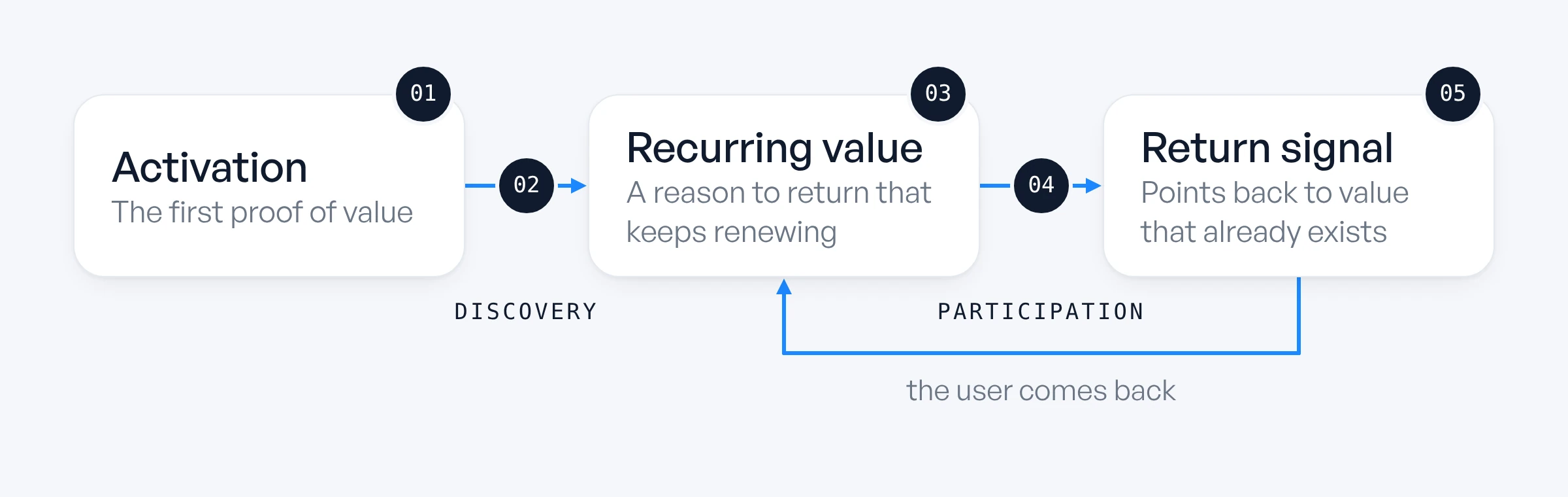
A declining retention curve is an outcome, not a diagnosis. We look for the earliest broken link in the lifecycle.
The activation break
Users do not reach the first meaningful outcome. The evidence is a steep early drop-off and weak completion of the core setup or action. Fix the product path before adding more messages. More traffic into a blocked funnel only produces a larger queue at the blockage.
The recurring-value break
Users activate but the experience does not materially change. They understand the app; they simply have no new reason to return. The fix is usually product depth, useful content, progress, personalization, or interaction, not a more urgent push notification.
The discovery break
Valuable features exist but too few users encounter them. Compare eligible users with visitors, then inspect entry points, badges, contextual prompts, and onboarding. Discovery should happen where the need arises, not only behind a navigation label users have not learned to interpret.
The participation break
Users visit but do not contribute or receive a response. Empty states, broad prompts, delayed replies, unclear norms, and visible low-quality content all raise the cost of participation. Give people a specific first action and make the first useful response fast enough to teach the loop.
The return-signal break
Something relevant happens, but the user never learns about it. Instrument replies, mentions, challenge milestones, group activity, and other high-intent events. Then use cooldowns and preference controls so that a helpful signal does not become notification confetti.
How community changes the retention model
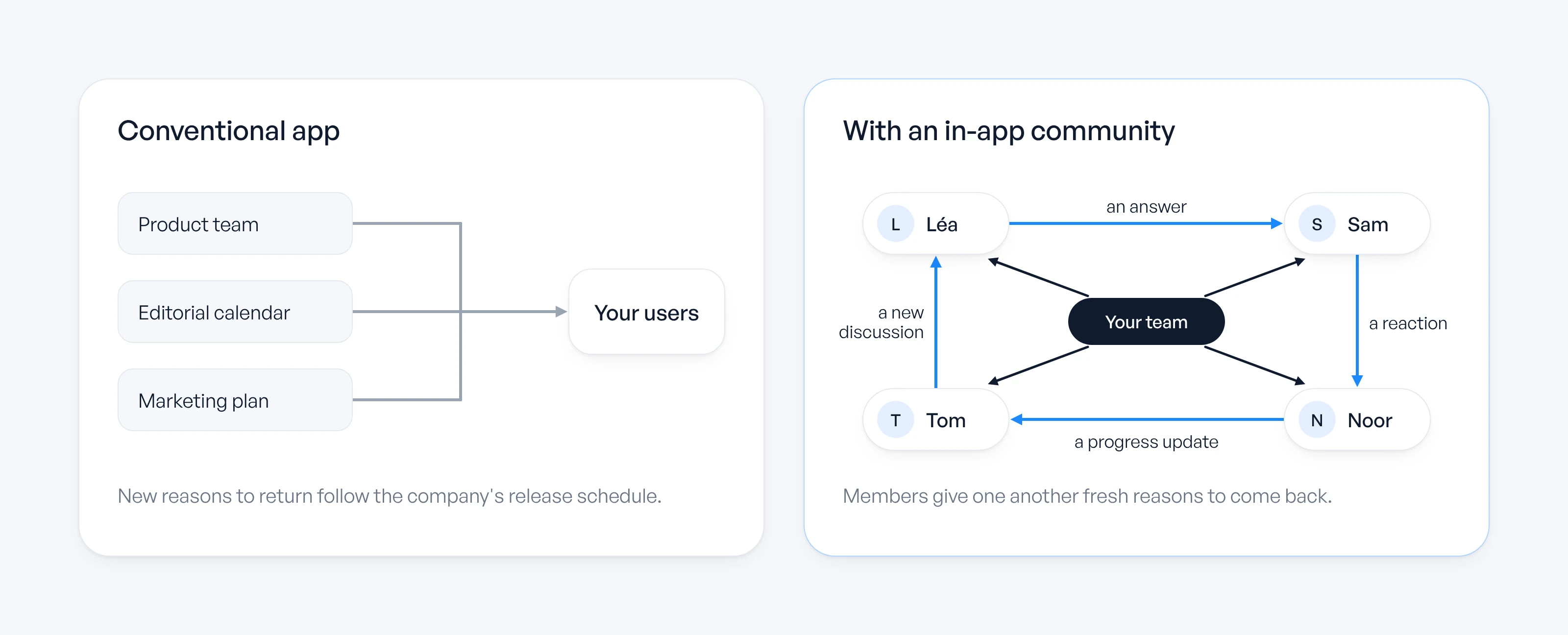
In a conventional app, most new value must come from the product team, editorial calendar, or marketing plan. In an in-app community, users can create value for one another: an answer, a reaction, a progress update, a useful post, or a new discussion. The next reason to return no longer depends entirely on the company's release schedule.
That mechanism only works when community is part of the product journey. We recommend a visible entry point, single sign-on, contextual discovery, a clear first contribution, event-based notifications, and moderation that keeps the useful material visible. Gamification can reinforce real contributions, but points cannot rescue an empty participation loop.
Octopus packages those components as an engagement layer inside the existing app: native feeds and groups, profiles, gamification, notifications, analytics, and multilingual moderation. The purpose is not to bolt a miniature social network onto every screen. It is to add the interaction that makes the app's existing value more useful and more repeatable.
What we have learned from controlled client rollouts
RunMotion Coach used a 90/10 Android control-group rollout. Users with community access showed 40% higher retention than the control group and opened the app 3.7 times as often. Monthly challenges gave runners a concrete reason to participate, while a badge and targeted notifications brought them back to active conversations.
Hotspot Shield later ran a 50/50 iOS test. By week 12, the cohort offered community access showed 8.4% higher overall retention. The strongest engagement shift came after the team combined a community badge with notifications: daily community users rose from roughly 800 to 8,000. The mechanism matters here. The product did not rely on a feed quietly waiting to be discovered.
Bankin used a 70/30 test over six months and measured 34.5% higher one-month retention among community users, alongside twice as many sessions. A weekly notification also lifted post views by 122% and comments threefold. Because community-user comparisons can contain self-selection, we keep that qualification attached to the exact claim instead of weakening every number in the article.
These examples point to the same operating rule: access alone is not the intervention. Discovery, a relevant participation format, return signals, and safe operations create the loop. Measurement tells us whether that loop improves the app rather than merely adding activity.
A practical operating model
Start by naming the retention outcome and interval. Then define the behavior that should create recurring value, instrument the path to it, and identify the earliest lifecycle break. Choose the smallest product change that addresses that break. If retention is the business case, expose comparable cohorts and keep a control group where feasible. Review behavioral, retention, and guardrail metrics together.
For community, we would launch one complete loop before expanding formats: a discoverable entry point, a reason to contribute, a useful response, and a relevant signal to return. Once that loop works, add groups, challenges, richer gamification, or broader content programs based on observed behavior.
Build an engagement system that earns the next session
We do not recommend chasing activity for its own sake. Find the repeatable value, make it easy to reach, give the user a reason to participate, and measure whether the result changes retention. When user-to-user interaction belongs in that loop, we provide the native community, engagement, analytics, and moderation infrastructure to operate it inside the app. Book a demo to discuss the lifecycle break you want to solve.
Frequently asked questions
What is a good mobile app engagement rate?
There is no universal rate that is useful without product context. Define the action that represents value, compare it by cohort, and test whether completing it predicts retention. A lower frequency can be healthy for an app designed around occasional high-value use.
Which comes first, engagement or retention?
Engagement happens inside the experience; retention confirms that the experience created another reason to return. Operationally, define the value event first, then measure its relationship with later retention.
Does sending more push notifications improve retention?
Not by itself. Notifications work best when they signal new, personal, or time-sensitive value. Measure incremental return alongside opt-outs and other guardrails. If the destination is not useful, more delivery only reveals the problem faster.
How should we prove that community improves retention?
Use a controlled rollout when feasible, measure the full cohort offered access, and report participant behavior separately. Define the time window, platform, and comparison basis. This separates causal evidence from the useful but observational fact that active community members often retain better.
How often should mobile app engagement be measured?
Review value events frequently enough to catch a broken product loop, but judge retention on an interval that matches the app's natural rhythm. A daily product may support daily review. A product tied to pay cycles, travel, or occasional projects needs a longer window. Keep the cohort definition stable so the trend remains comparable.
Can an app have high engagement but poor retention?
Yes. Promotions, novelty, or aggressive notifications can create busy sessions without creating repeatable value. Compare the behavior with later retention and monitor guardrails such as opt-outs, support contacts, and cancellations. High activity is useful only when it advances the product outcome and earns another visit.