TL;DR
Customer sentiment analysis identifies the opinions expressed in reviews, surveys, support conversations, social posts and community discussions. Useful analysis connects sentiment to a topic, customer segment, product moment, volume and trend, then sends teams back to the original language. We recommend treating sentiment as a directional signal rather than a verdict. It can show where to investigate, communicate or respond, but it cannot prove satisfaction, loyalty, purchase intent or churn on its own.
A sentiment score can tell a team that the mood changed. It cannot tell the team what to do unless the change is connected to a topic, audience and product moment.
That is where most programs go wrong. They compress thousands of comments into one number, celebrate or panic, and then reopen the comments to understand what the number meant. The score should be an index into the evidence, not an escape from reading it.
What is customer sentiment analysis?
Customer sentiment analysis is the process of identifying and measuring opinions expressed in customer language. It uses rules or machine-learning models to classify text as positive, negative, neutral or mixed, often with a score or confidence value.
Google Cloud's sentiment documentation describes analysis at document and sentence level, with separate score and magnitude values. Tools use different labels and scales, so teams should document what the output means before comparing sources or periods.
Sentiment is an interpretation of language. It does not establish why a person feels that way or what the person will do next.
Sentiment is not satisfaction, loyalty or intent
Customer satisfaction usually comes from a direct question about whether an experience met expectations. Sentiment infers the tone of language someone chose to use. A satisfied customer can criticize one feature, and an unhappy customer can praise a helpful support response.
The same distinction applies to loyalty and churn. Negative language may be a committed user asking the product to improve. Positive language may come from someone who never purchases again. Link sentiment to behavior when the decision requires a behavioral claim.
We use sentiment to prioritize investigation and response. We do not treat it as a prediction of every customer's future.
Choose sources that represent the question
Reviews, survey responses, support tickets, call transcripts, emails, social posts and community discussions capture different moments. A store review may summarize the whole relationship. A support ticket usually centers on one problem. A community thread can reveal how several customers interpret the same release.
Every channel contains selection bias. The people who speak are not automatically representative of everyone who uses the product. Segment by source and keep volume visible so a loud minority is not mistaken for the whole customer base.
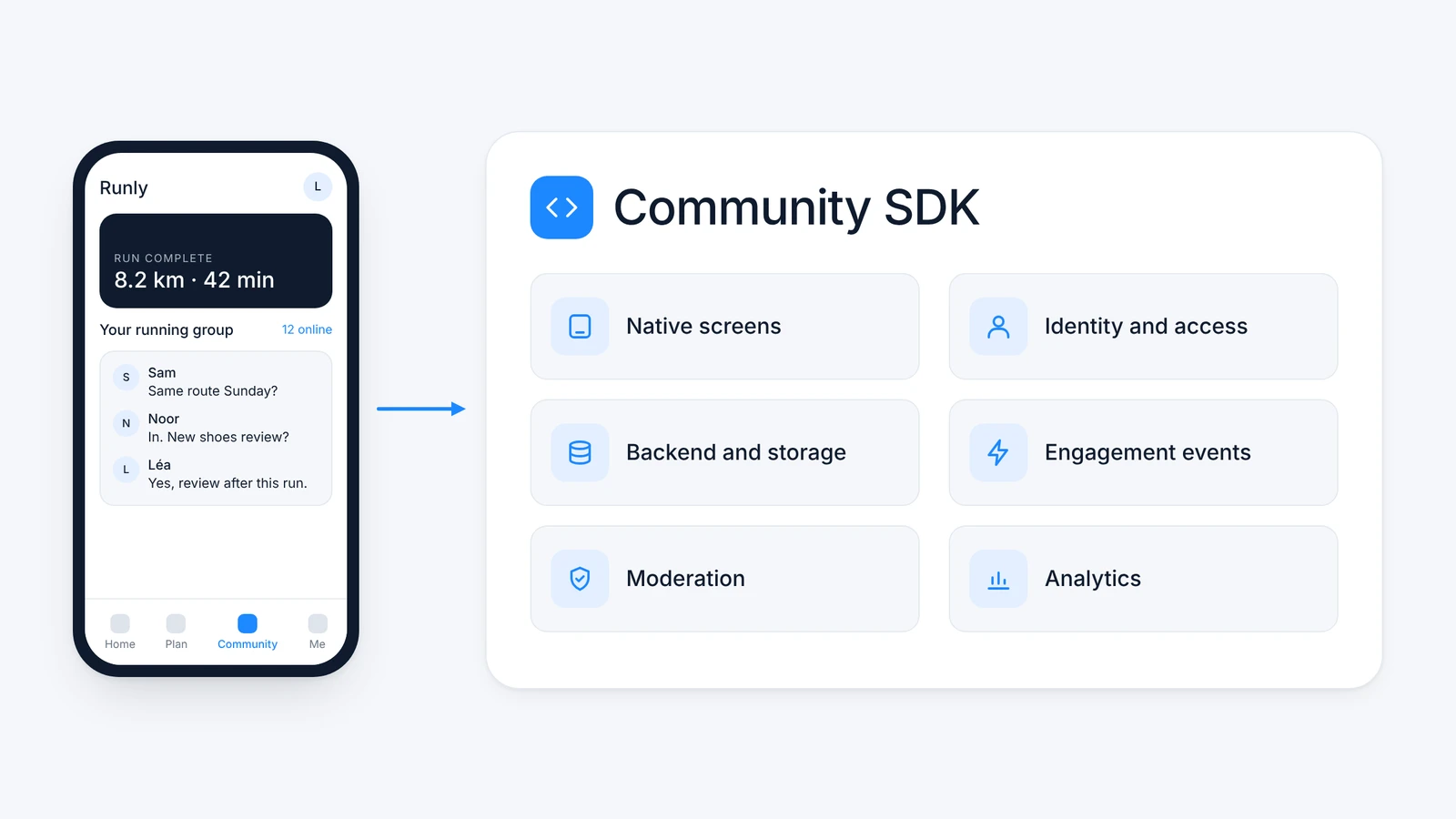
An in-app community adds a continuous first-party source close to the product experience. Members can discuss features, answer polls and react to changes without moving to a separate research platform. That immediacy is valuable, but it still represents participants rather than every silent user.
How does customer sentiment analysis work?
A useful workflow has six stages.
- Define the question. Decide whether the team is investigating a release, feature, audience, support issue or broader brand trend.
- Collect relevant language. Select channels, segments and time periods that can answer that question.
- Prepare the data. Remove duplicates, detect language, preserve dates and identifiers, and separate messages into analyzable units.
- Classify sentiment. Assign labels or scores with a documented model and confidence threshold.
- Connect sentiment to topics. Identify the feature, issue or entity the opinion concerns.
- Validate and act. Read representative comments, compare other evidence and assign the next decision.
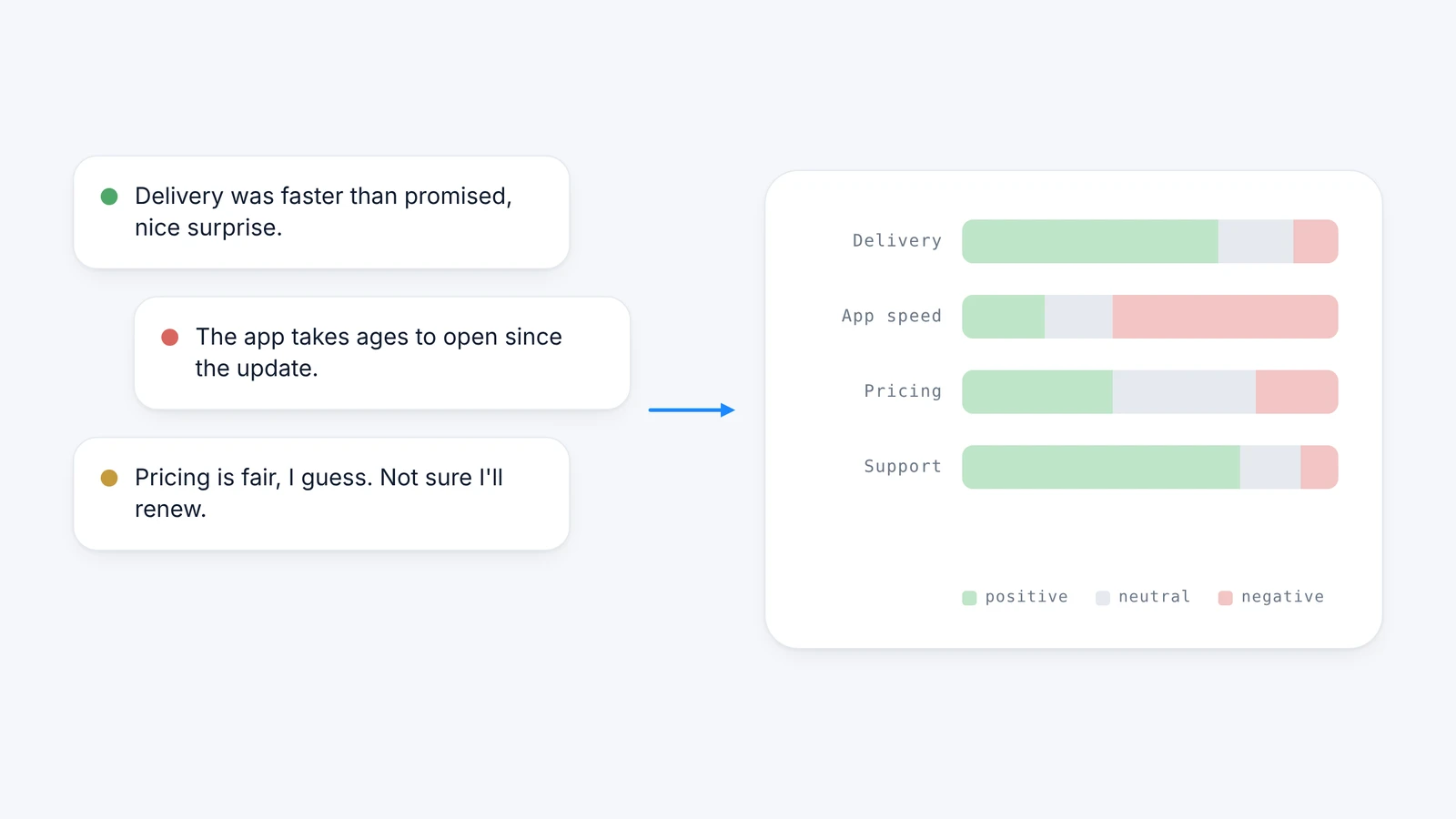
Topic-level analysis is essential. “The design is excellent, but the price increase is impossible to justify” contains two different opinions. Amazon Comprehend's targeted sentiment documentation distinguishes overall document sentiment from sentiment attached to a specific entity or attribute.
Read sentiment with volume, segment and direction
An overall score can hide the pattern the team needs.
| Pattern | Plausible interpretation | Next move |
|---|---|---|
| Negative sentiment rises after a release | A workflow, bug or expectation may have changed | Compare topics, versions and support data |
| Sentiment drops in one language only | Translation, market context or local policy may differ | Review native-language examples with local expertise |
| Positive sentiment rises but usage falls | Customers like the idea but do not adopt it | Inspect product friction and behavior |
| High activity and negative sentiment coincide | The issue is visible and emotionally important | Prioritize response and product investigation |
| A large score shift comes from few comments | The sample may be unstable | Keep watching and collect more evidence |
Track mention volume, share of relevant feedback, topic, segment and representative language beside the score. Direction over time is often more useful than the absolute value because models and communities have different baselines.
Keep sentiment, engagement and moderation separate
These systems use some of the same content but answer different questions.
- Engagement measures what people do: view, post, react, reply, vote or return.
- Sentiment interprets the opinion expressed in language.
- Moderation decides whether content complies with policy and what action to take.
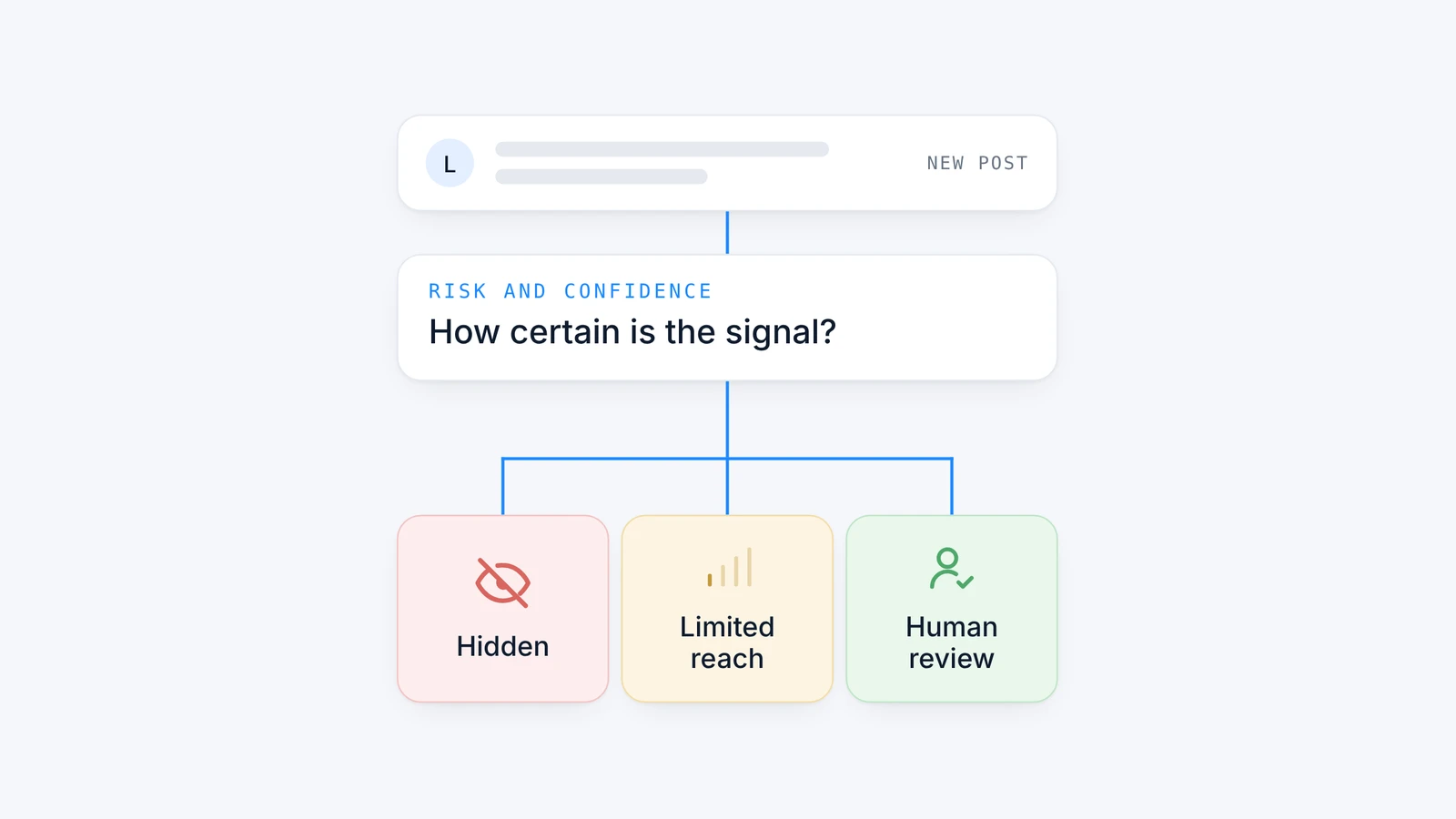
A negative comment is not automatically harmful. It may be valuable product criticism. A positive-sounding sentence can still contain prohibited content. Teams damage trust when they use sentiment as a hidden removal rule for any criticism.
Sentiment can support moderation or customer care by prioritizing a possible escalation, but policy should decide the enforcement action. Community analytics then combines the sentiment signal with participation, behavior and business outcomes.
“Never roll back a launch because the sentiment score dropped in week one. When a parenting app replaced its chat with a community, members complained loudly at first, then adapted quickly. Before any decision, I want the volume, who is talking and what those people actually do in the app. Criticism usually comes from your most engaged users. They are telling you what to fix first.”
Grégoire Mercier, Co-founder and CEO, Octopus Community
How we use sentiment at Octopus
Our sentiment dashboard scores posts, polls and comments, then clusters the conversation into topics. It provides a live community score from 0 to 100, a priority watchlist for emerging issues and a written summary each morning. Teams can also ask questions about the community in plain language and receive a sourced answer.
The dashboard is multilingual by default. That matters because translating everything into one language before analysis can strip away local phrasing and context. The original content should remain available for review, and moderation should evaluate the original text.
We recommend using the watchlist to route attention, then opening the topic and comments that produced the signal. The operator still decides whether the next step is a product investigation, support response, community post or no action yet.
What client use cases teach us
Hotspot Shield used product polls inside its community to ask about interface and usage patterns. Its largest poll received almost 10,000 responses. Poll answers are stated preference rather than inferred sentiment, which makes them a useful complement: the team can compare what members select with how they discuss the same topic and what they do in the app.
Hellowork combines custom moderation rules and sentiment analysis to identify posts that are highly negative toward the brand or may need customer-support escalation. The goal is not to remove criticism. It is to give the team time to understand and respond before frustration compounds.
These examples show two different jobs: structured research and continuous issue detection. They should not be collapsed into one score or one success metric.
Turn a signal into a decision
We use a simple operating rule: every important sentiment change needs an owner, supporting examples and a next question.
Product teams may investigate a release or workflow. Support teams may contact affected customers or clarify guidance. Marketing teams may test whether messaging created an expectation gap. Community teams may publish an acknowledgment, open a poll or bring the right expert into the discussion.
The action should match the evidence. Eight negative comments may justify reading and monitoring. Eight thousand comments across several segments may justify an incident response. A dashboard that cannot show the difference is decorative analytics.
Hear the signal without losing the conversation
Octopus combines first-party community discussions, polls, topic clustering and multilingual sentiment in the same in-app environment. Explore how community data supports product and CRM decisions or book a demo to review the insight workflow for your app.
Frequently asked questions
What data can customer sentiment analysis use?
It can analyze reviews, open survey responses, support conversations, emails, call transcripts, social posts and community discussions. Select sources based on the question and document which customers each channel represents.
How is sentiment analysis different from customer satisfaction?
Sentiment infers opinion from language. Customer satisfaction usually asks customers directly whether an experience met expectations. The signals can support one another, but they are not interchangeable.
Why should sentiment be analyzed by topic?
One comment can praise one aspect and criticize another. Topic or targeted sentiment connects the opinion to the relevant feature, price, service or event, making the result more actionable than one overall label.
How accurate is customer sentiment analysis?
Accuracy varies by model, language, domain and available context. Sarcasm, slang, mixed opinions and cultural references create errors. Test the system on real customer language and review representative comments behind important trends.
Can sentiment analysis predict churn?
Sentiment can contribute to a churn model, but it cannot prove that a customer will leave. Combine it with product usage, support history, account changes and retention behavior, then validate the prediction against outcomes.
Should negative customer comments be moderated?
Not because they are negative. Criticism can be valuable and should remain visible when it follows community policy. Moderation should act on policy violations; sentiment should help teams understand and route customer feedback.