TL;DR
AI content moderation uses machine-learning models to interpret user-generated content and estimate whether it violates a policy. It is one decision layer inside a wider safety operation, not a replacement for rules, reporting, enforcement, human review, appeals, or measurement. We recommend automating clear, high-confidence decisions, routing sensitive or ambiguous cases to trained reviewers, and measuring errors by severity rather than celebrating one global accuracy number.
AI can review more content than a human team can read manually. It cannot decide what a community should permit, understand every local context, or carry accountability for a bad enforcement decision. Those are operating decisions.
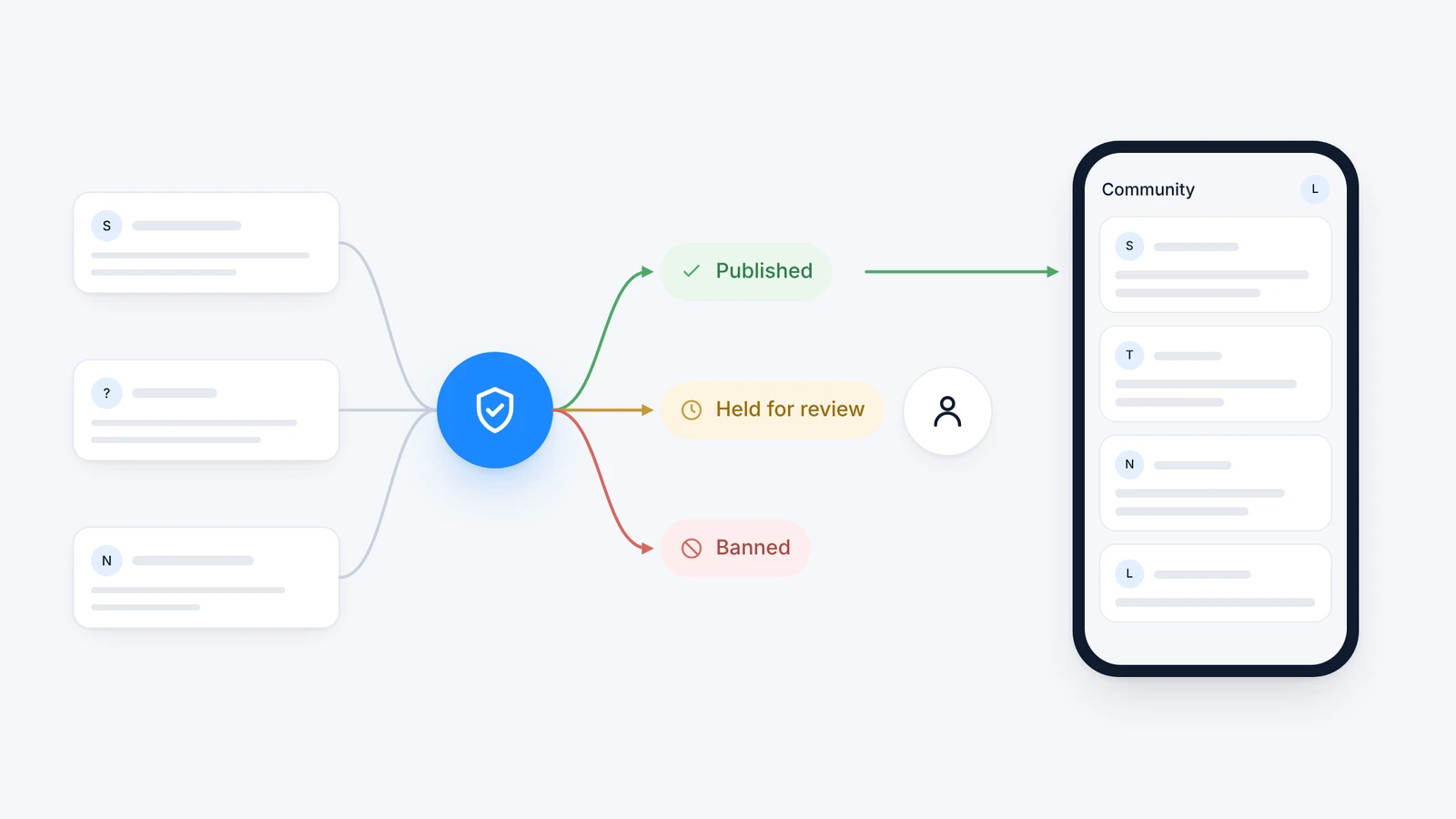
We use AI content moderation as one layer in a complete safety system. The model interprets content and produces a score or classification. Policy turns that output into an action. Human governance decides where automation is acceptable, which cases need review, and how the system learns from mistakes.
What is AI content moderation?
AI content moderation applies machine-learning models to user-generated content. Natural language processing can evaluate text, while other classifiers can assess images or additional formats for categories such as harassment, hate, sexual content, threats, spam, or self-harm risk. Unlike a simple keyword rule, a contextual model can consider the relationship between words and the surrounding message.
That difference matters. A banned word can appear in abuse, in a member quoting abuse to report it, or in a support conversation about the rule itself. Keyword detection sees the same token. A contextual model can estimate the meaning, but it still operates with uncertainty.
AI moderation is therefore not synonymous with automated moderation. Automated moderation is the wider set of mechanisms that can act without a reviewer: keyword filters, link rules, rate limits, duplicate detection, model scores, member reputation, reports, and automatic account actions. This guide focuses on the model-based decision layer and the human governance around it.
How AI fits into a complete moderation system
A reliable system begins with policy, not a model. The operator defines prohibited and restricted behavior, the context that changes a decision, and the action attached to each level of risk. Only then can the technical layers implement that policy.
For iOS apps with user-generated content, Apple's App Review Guidelines require safeguards that include filtering objectionable material, reporting with timely responses, blocking abusive users, and published contact information. These controls are not optional extras around the model. They are part of the product operation.
1. Deterministic pre-filters catch clear patterns
Rules can block known spam links, prohibited contact details, repeated messages, or terms that always violate a narrow community policy. They are fast and easy to explain. They also break when meaning depends on context, spelling changes, or users discuss the prohibited subject legitimately.
2. AI evaluates context and severity
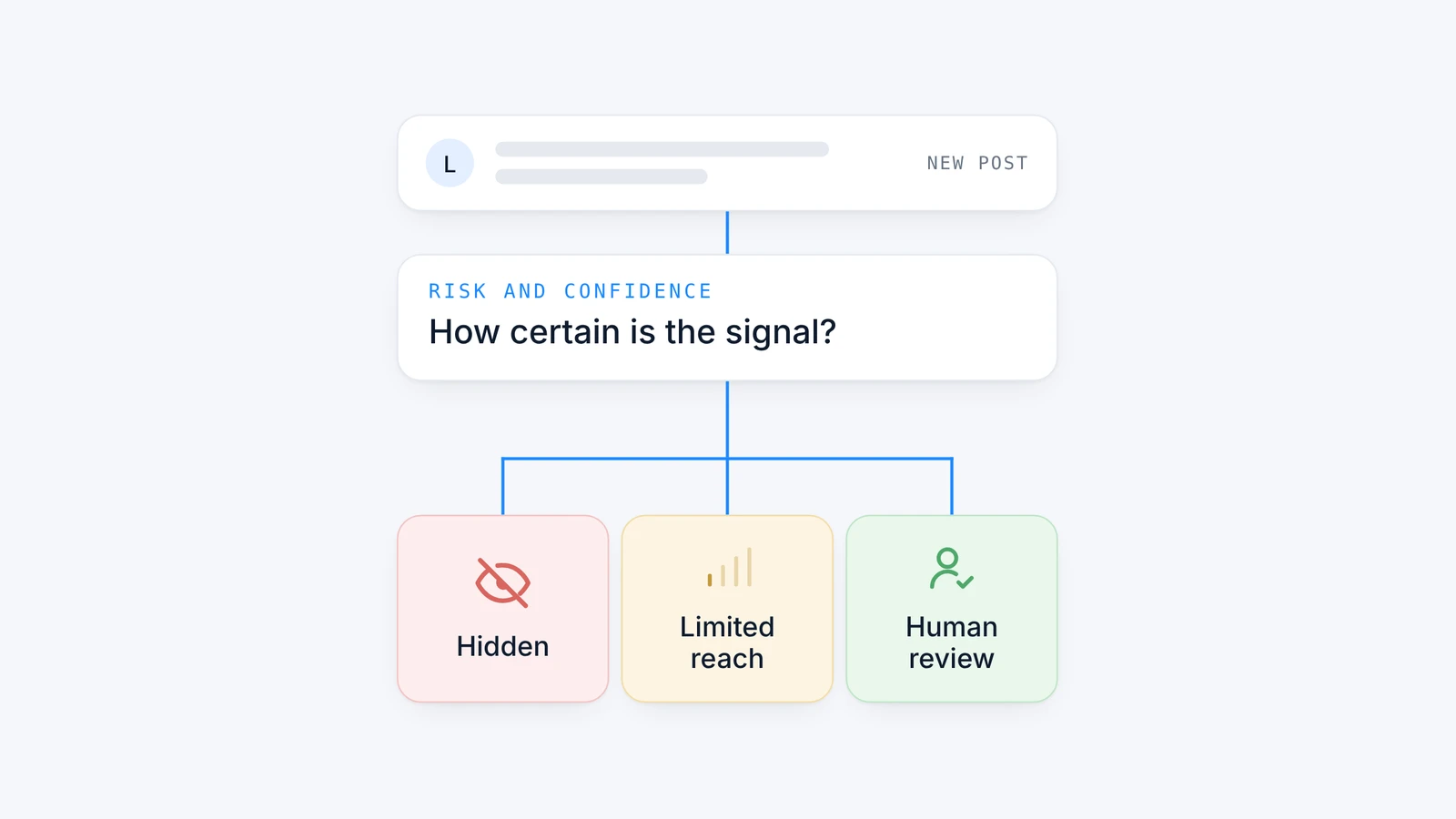
The model assesses the content against defined categories and returns scores or labels. High-confidence, high-severity material can be blocked or hidden before publication. Clearly acceptable content can continue. The uncertain middle should not be forced into a confident answer merely because the workflow prefers tidy boxes.
3. Policy converts a score into an action
A model score has no operational meaning until a policy sets thresholds. The same score might trigger a warning in one community, temporary concealment in another, or a review queue in a third. Age, legal exposure, brand risk, conversation type, and the cost of a false positive all affect the choice.
4. Reports and human review handle what the model cannot
Members surface emerging abuse, coded language, impersonation, and patterns spread across several interactions. Reviewers interpret context, decide edge cases, manage escalations, and correct the system. The review process also needs response targets and severity rules; a queue is not a safety strategy.
5. Feedback changes rules and thresholds
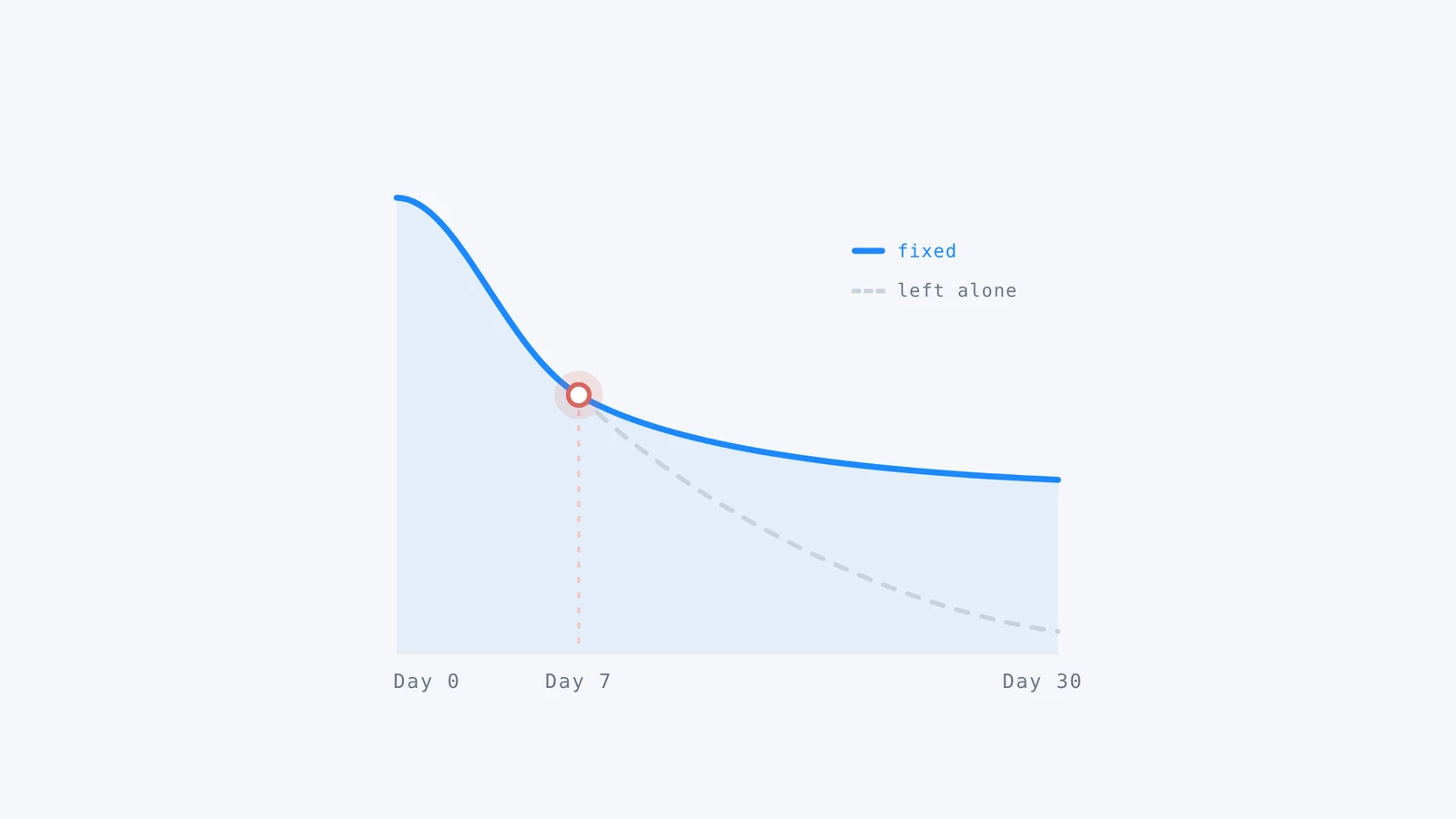
Appeals, overturned decisions, repeat reports, reviewer disagreement, and newly observed abuse patterns should feed a regular calibration process. Without this loop, the model and policy slowly drift away from the community they are meant to protect.
Where AI creates real operational value
The strongest use case is first-pass coverage at a scale or speed that manual review cannot match. AI can examine all submitted content before or immediately after publication, apply the same initial categories, and prioritize the material most likely to cause harm.
That changes the human role. Reviewers spend less time clearing obvious spam and more time on ambiguity, severity, appeals, and policy calibration. We recommend using automation to remove repetitive volume, not to remove human responsibility.
AI can also make multilingual operations more consistent when it supports the languages members actually use. The important test is not whether a provider says “multilingual.” Ask which languages are supported, how performance is evaluated by language, and what happens when the model's confidence is low.
Where AI moderation fails
Context is the hard part. Humor, reclaimed language, sarcasm, cultural references, quoted abuse, private history, and coordinated behavior can all change the meaning of a message. A model examining one item may not see the relationship between several individually acceptable actions.
False positives silence legitimate users and can make support or vulnerable communities feel hostile. False negatives leave harmful content visible. Those errors do not have equal cost. Missing a credible threat is not equivalent to temporarily holding an ordinary disagreement for review.
Models also inherit limitations from training data and evaluation design. Performance can vary across languages, dialects, topics, and community norms. A single global accuracy figure hides those differences and says little about the mistakes that matter most.
Human review is a control system, not an admission of failure
We recommend human review for sensitive categories, low-confidence decisions, member appeals, high-impact account actions, and cases where meaning depends on conversation or cultural context. Reviewers should have the policy, relevant history, model rationale or category, and a clear escalation path.
The NIST Generative AI Profile similarly recommends human moderation where appropriate, especially when models perform poorly or social and cultural context matters. It also connects responsible operation with monitoring, feedback, appeals, and overrides. Those mechanisms make automated decisions governable.
Human review does not mean reading every post. It means placing people where judgment and accountability are required. The operational target is the right division of labor: machines provide coverage and prioritization; people handle ambiguity, impact, and improvement.
“I would never let AI make the final call on a member report. A report means someone felt hurt or unsafe, and they deserve a person looking at it. Our system can hide reported content while it waits, but a human always decides. For everything else: if a mistake is cheap and easy to undo, automate it. If the case is ambiguous or touches someone's safety, a human decides.”
Grégoire Mercier, Co-founder and CEO, Octopus Community
App-store requirements are the baseline, not the strategy
Those platform requirements establish a minimum operating baseline. They do not choose the policy, thresholds, response targets, reviewer access, or escalation path for a specific community.
Meeting the baseline does not tell a team which behavior harms its particular community, how quickly severe cases should be handled, or what evidence is needed for an account action. Those choices belong in a written policy and escalation design that engineering, support, legal, product, and community teams can all follow.
The DSA and Online Safety Act raise the regulatory baseline
App-store rules are no longer the only external baseline. The EU Digital Services Act became fully applicable on 17 February 2024. For services within scope, it adds duties around accessible reporting of illegal content, explanations for moderation decisions, appeals, and transparency. Obligations vary by a service's role, size, and impact, so teams should confirm scope instead of copying the compliance program of a very large platform.
The UK Online Safety Act takes the same systems-level view. Ofcom's compliance guide for online services, last updated on 21 May 2025, tells in-scope services to assess illegal-content risk, keep records, implement safety measures, and determine whether child-safety duties apply. Many of those duties are ongoing.
For product teams, the practical consequence is auditability. Policy, reports, reasons, appeals, records, and human escalation need to be designed into the moderation workflow. AI can classify and prioritize content, but it cannot carry those governance duties by itself. This is an operating interpretation, not legal advice; each service should confirm which duties apply.
How we operate moderation at Octopus
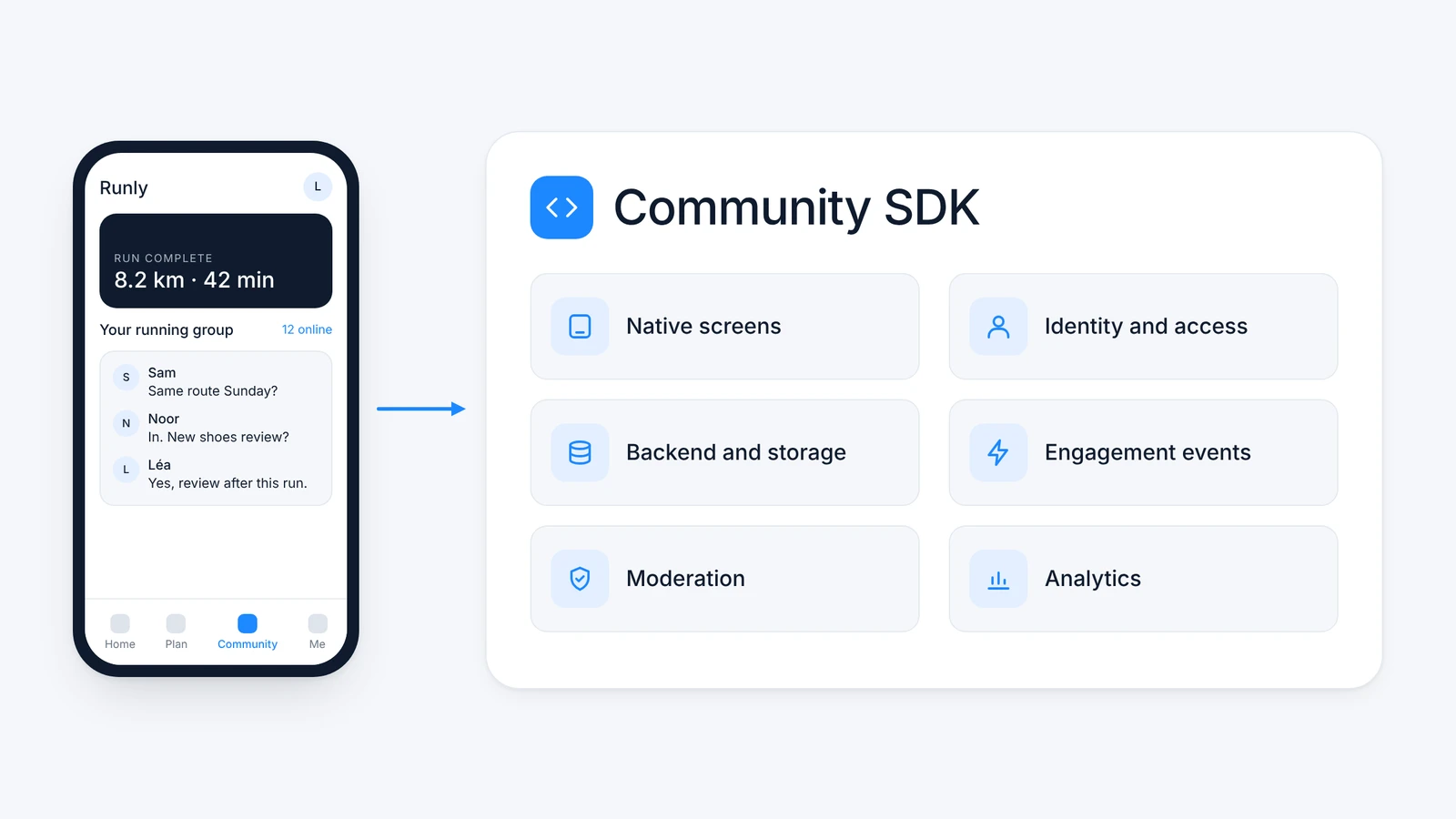
Our moderation follows the layered model described in our guide to automated content moderation: keyword pre-filtering, AI contextual scoring, community reports, human review, and optional client dashboard control. Our AI moderation checks every piece of content before it goes live, and sensitive edge cases go to our own human moderation team. The core moderation service is included with every Octopus SDK, so clients do not need a dedicated moderation team. The policy layer is what changes most from one app to the next, as the three client setups below show.
Multilingual coverage is operationally important because communities do not become single-language spaces merely because the product launched in one market. Octopus moderates content in any language, on the original text. Instant translation is a separate optional feature, off by default, while human escalation remains available for decisions that need context.
20 Minutes: scale without a full-time moderation burden
20 Minutes runs an app community for a media brand with 16 million-plus monthly users. The implementation uses custom rules for a news environment, automatic shadowbanning, community reports, and human escalation. The client reports zero hours of community management by its own team and no crisis in ten months of operation. That outcome comes from the full operating design, not from an AI score alone.
Opla: marketplace-specific rules
Opla needed rules for a marketplace where external promotion changes the value of the conversation. Its configuration blocks external URLs except opla.co and filters competitor references unless they are positive for Opla. This is a useful example of why policy must precede automation: a generic toxicity model would not know that an otherwise harmless link violates a marketplace rule.
Hotspot Shield: multilingual, privacy-sensitive moderation
Hotspot Shield operates a global community around privacy and security. Its moderation combines multilingual analysis, tailored rules, reports, and automatic shadowbanning. The subject matter makes both language coverage and contextual escalation important; a generic English-only filter would leave obvious operational gaps.
How to measure moderation quality
Start with coverage: what proportion of eligible content is evaluated, and how quickly? Then measure precision and recall by policy category, language, and severity. Track false positives, false negatives found through reports or audits, appeal rates, overturned decisions, reviewer agreement, time to action, and repeat-offender patterns.
Do not compress all of that into one “accuracy” number. Weight errors by impact and inspect the categories that matter to the community. A 99% figure can still hide a system that routinely misses the rare event the safety program exists to catch.
Operational metrics matter too. Review-queue age, escalation response, moderator workload, policy-change frequency, and user report outcomes show whether the system works after detection. The best model in a neglected workflow is still a neglected workflow.
Design the safety operation before choosing the model
AI content moderation works when policy, thresholds, human judgment, feedback, and measurement surround it. We recommend starting with the harm you need to prevent and the decisions you are willing to automate, then choosing the technical layer that can implement that design. Our AI moderation approach combines contextual analysis with configurable rules, reports, human review, and dashboard controls. Book a demo to review the policy and escalation model your app requires.
Frequently asked questions
Can AI fully automate content moderation?
We would not recommend it for a live community. Automate clear, repeatable decisions within defined thresholds. Keep human review for ambiguity, sensitive categories, appeals, and high-impact actions. The exact split should reflect the community's risk and policy.
What happens to a reported post while it waits for review?
At Octopus, a reported post can be hidden while it waits for review, and a post reported by several members is hidden automatically until a moderator has looked at it. A member of our moderation team always makes the final decision: a report means someone felt hurt or unsafe, and that deserves a human review.
Can two communities have different moderation rules?
Yes. Default policies cover hate speech, spam, harassment and illegal content. Each client then adds rules for its product: referral codes are blocked on Gamby, external links outside opla.co are blocked on Opla, and nudity rules are relaxed for pregnancy photos on iMamma.
Does multilingual moderation mean translating everything into English?
Not necessarily, and translation alone can lose meaning. Ask how the system handles each supported language, dialect, context, and confidence threshold, and where native-language human review is available for sensitive cases.
How should teams set AI moderation thresholds?
Set thresholds by policy category, severity, and the cost of each error. A credible threat, ordinary disagreement, and marketplace link rule should not share one cutoff. Use high-confidence automation for clearly defined cases, route the uncertain middle to review, and adjust thresholds using appeals, audits, and reviewer outcomes.
How often should an AI moderation system be reviewed?
Review performance on a regular operating cadence and whenever policy, audience, language mix, product features, or abuse patterns change. Monitor false positives, false negatives, appeals, overturned decisions, and queue age continuously enough to catch drift. A model update should trigger focused validation before broader automation.
Does AI moderation make a community compliant with the DSA or Online Safety Act?
No. AI can support detection and prioritization, but compliance depends on the service's scope and its complete operating process. That can include risk assessments, reporting, explanations, appeals, record keeping, child-safety measures where relevant, and accountable human governance. Legal review should determine which duties apply.