TL;DR
An in-app community adds conversation, peer help, and shared activity to a mobile product people already use. The best communities are connected to the app's core job: a run, a purchase, an article, a game, or another meaningful user action. We recommend starting with one clear participation loop, native identity, strong moderation, and a measurement plan. A generic feed buried in a tab is not a strategy.
What is an in-app community?
An in-app community is a social space inside an existing mobile product. Users keep the same app, account, and context while they post, comment, react, join groups, answer questions, or share progress with other users.
The distinction matters. A fitness app does not become a social network with a training feature attached. It remains a fitness product, but runners can discuss a session, share a result, or help one another through a difficult week. A marketplace remains a place to buy and sell, but users can promote a listing, ask for advice, or build trust with other members. Community extends the product's value through people.
Sometimes adding a feed is enough because users already have something urgent to discuss. Most of the time, they need a reason to participate that belongs inside the product. A feed is an interface; the participation loop comes from a shared goal, question, achievement, or decision.
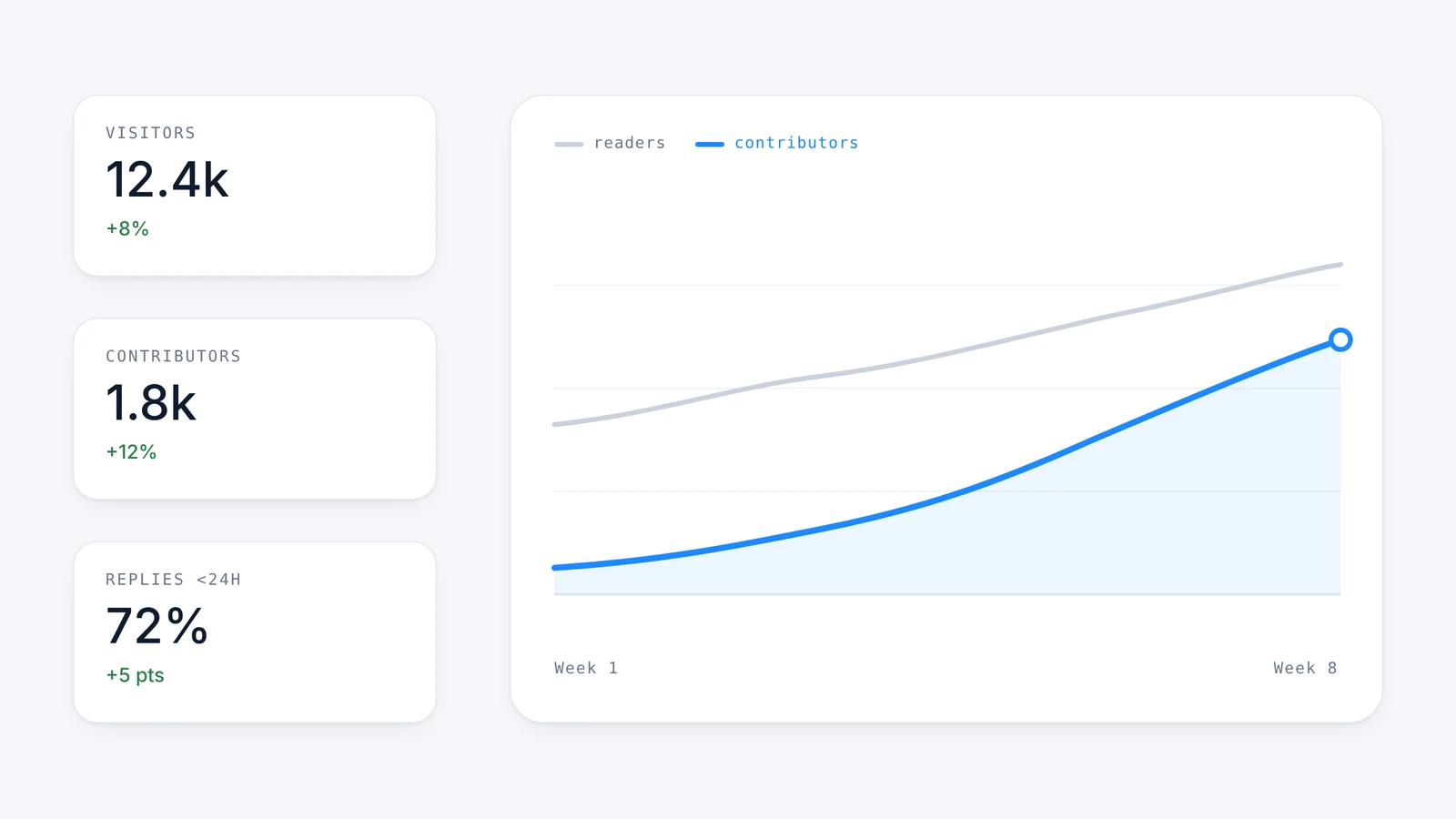
Unchaind shows the distinction clearly. In addiction recovery, peer support is part of the product value rather than an optional engagement layer. In a one-week iOS test, the app measured a 12% retention uplift; community users opened the app 1.8 times more often, and 58% of community visitors contributed. The community now runs without daily management from the Unchaind team.
Why mobile teams add community
It creates useful reasons to return
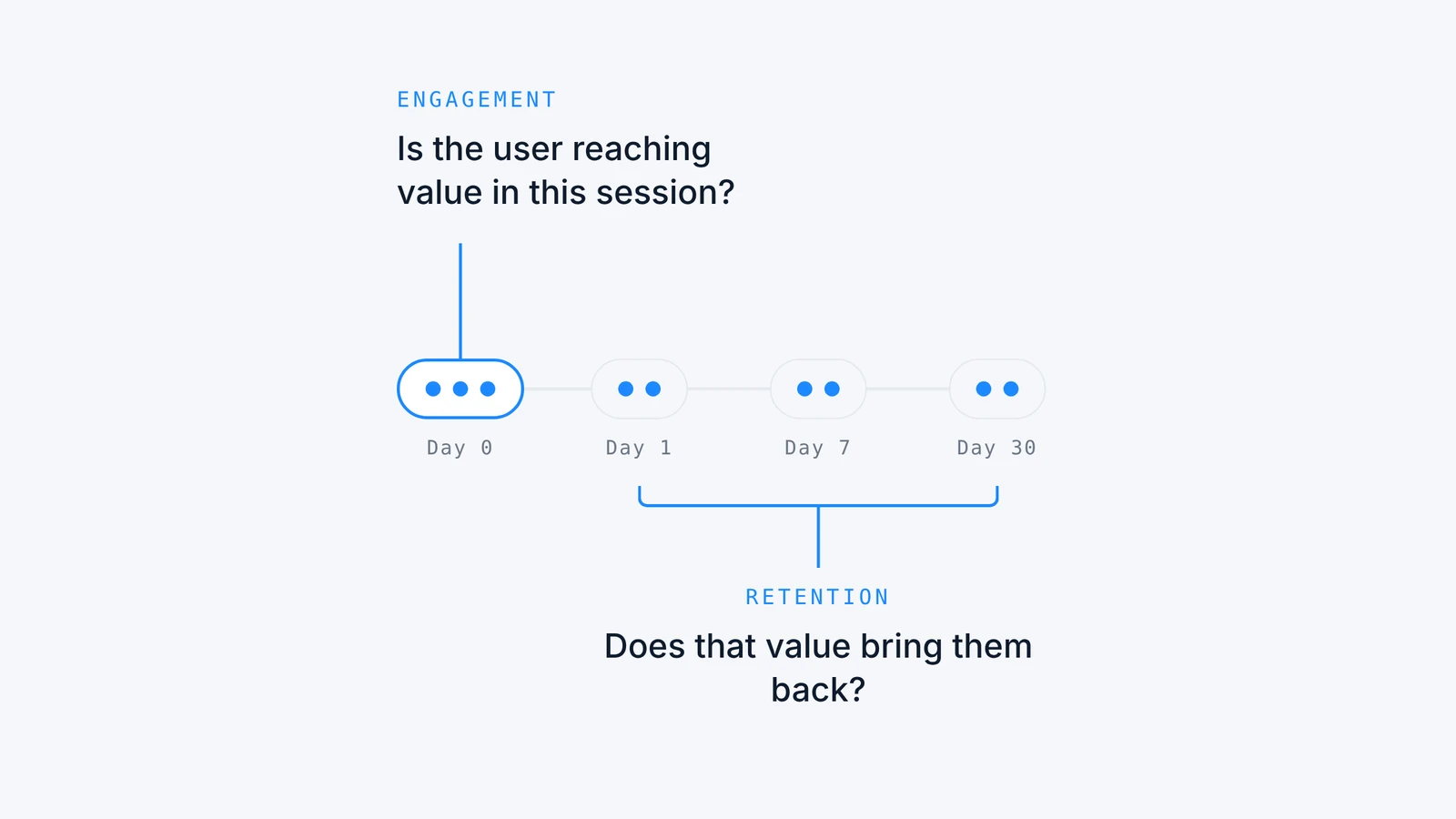
Most apps have a natural limit on how often their core utility is needed. A user opens a VPN, checks a bank balance, identifies a coin, reads an article, or completes a workout. Community creates return moments between those core actions because another person has replied, shared something relevant, or started a discussion worth joining.
That is the retention mechanism we care about. The notification itself is only the delivery method. The reason to return is the interaction behind it. Apple's User Notifications documentation and Android's notification guidance both frame notifications as a way to deliver timely information beyond an active app session. For a community product, that information should represent a real interaction, such as a reply or relevant group update, rather than a generic prompt to return.
RunMotion tested this with a control group and measured a 40% retention uplift, while community users generated 3.7 times more sessions. Its community also introduced recurring monthly challenges, giving runners a shared reason to check in between training sessions.
It turns customer conversation into product evidence
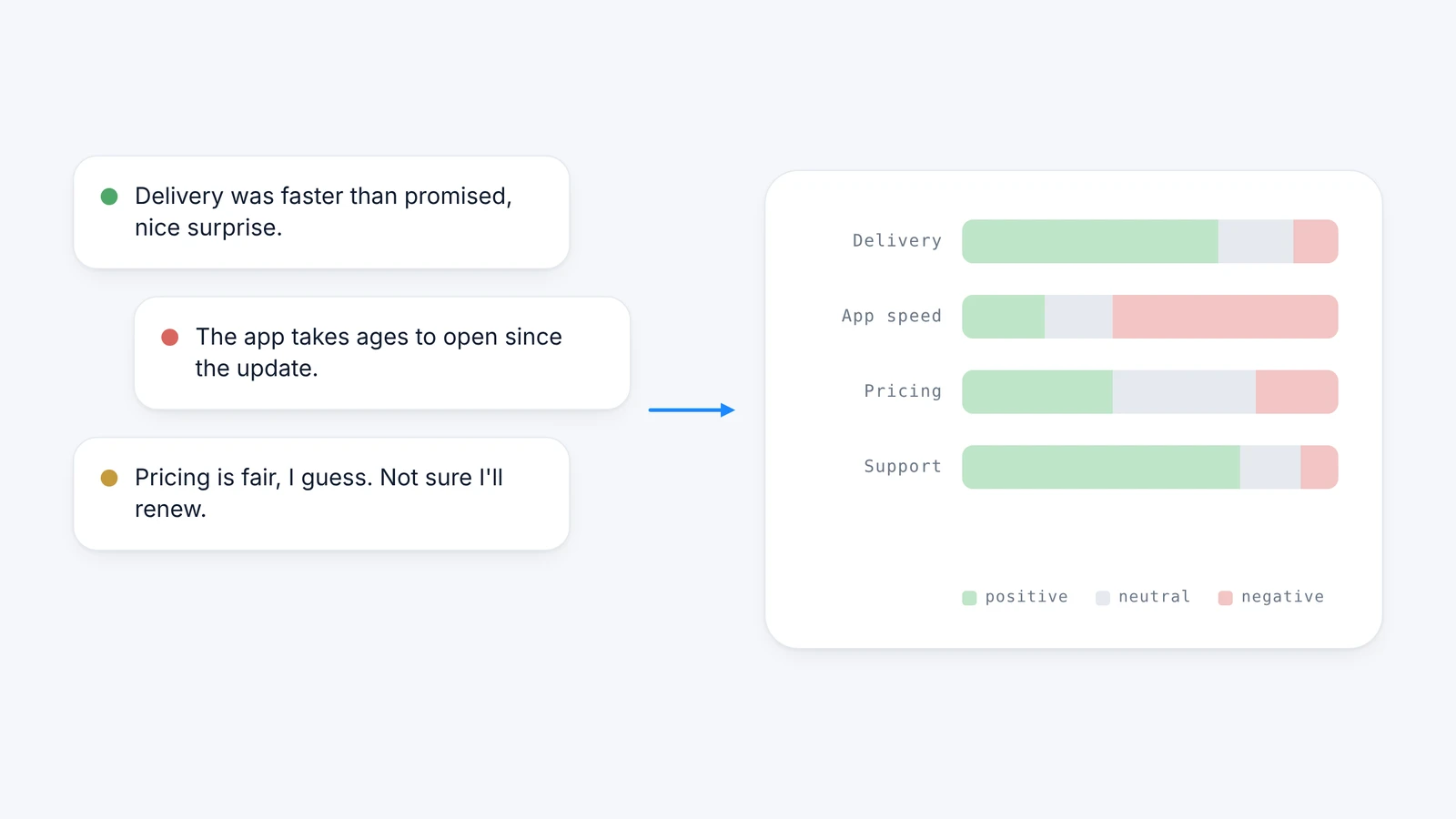
Support tickets and surveys capture selected moments. Community captures questions, frustrations, ideas, and preferences while users are already engaged with the product. Polls can test a decision quickly. Repeated questions expose onboarding gaps. Visible agreement around a problem can help a product team judge its importance.
Bankin' saw this effect when issues raised in its community gained enough visibility to align product, marketing, and leadership. Hotspot Shield used product polls to collect almost 10,000 responses on its largest question. The useful part is not the volume alone. The responses came from identifiable product users in a product context.
It lets users help one another
Many support questions do not require account access or a formal ticket. Experienced users can explain a feature, share a workaround, or reassure a new member. RunMotion reports that in more than one-third of cases, users answer before its support team needs to step in. At Kinomap, users answer 47% of questions before the support team needs to intervene. Bankin' used a pinned community post during a partner issue and deflected hundreds of related tickets.
We recommend treating peer support as part of the support system, not as a replacement for it. Sensitive, unresolved, and account-specific questions still need a clear route to the company.
How an in-app community works
Identity stays connected to the app
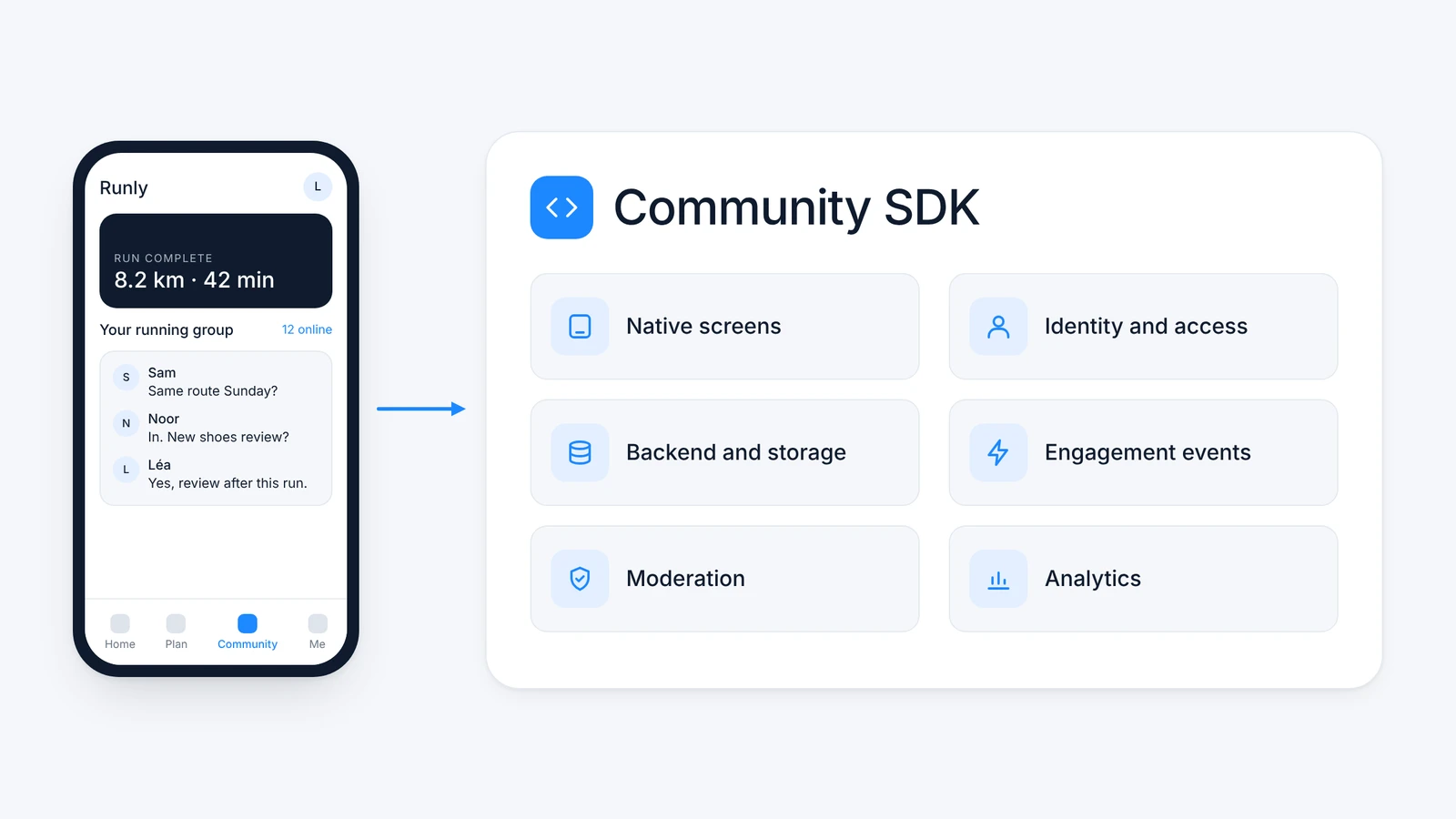
The community should use the app's existing identity. Single sign-on avoids a second registration flow, while a unified profile keeps community activity attached to the user experience the product already owns. Access rules can also reflect subscription status, employee roles, beta cohorts, or other product data.
We consider this connection essential. A separate login tells users they have entered another product. A shared identity tells them the community belongs where they already are.
Conversation starts from product context
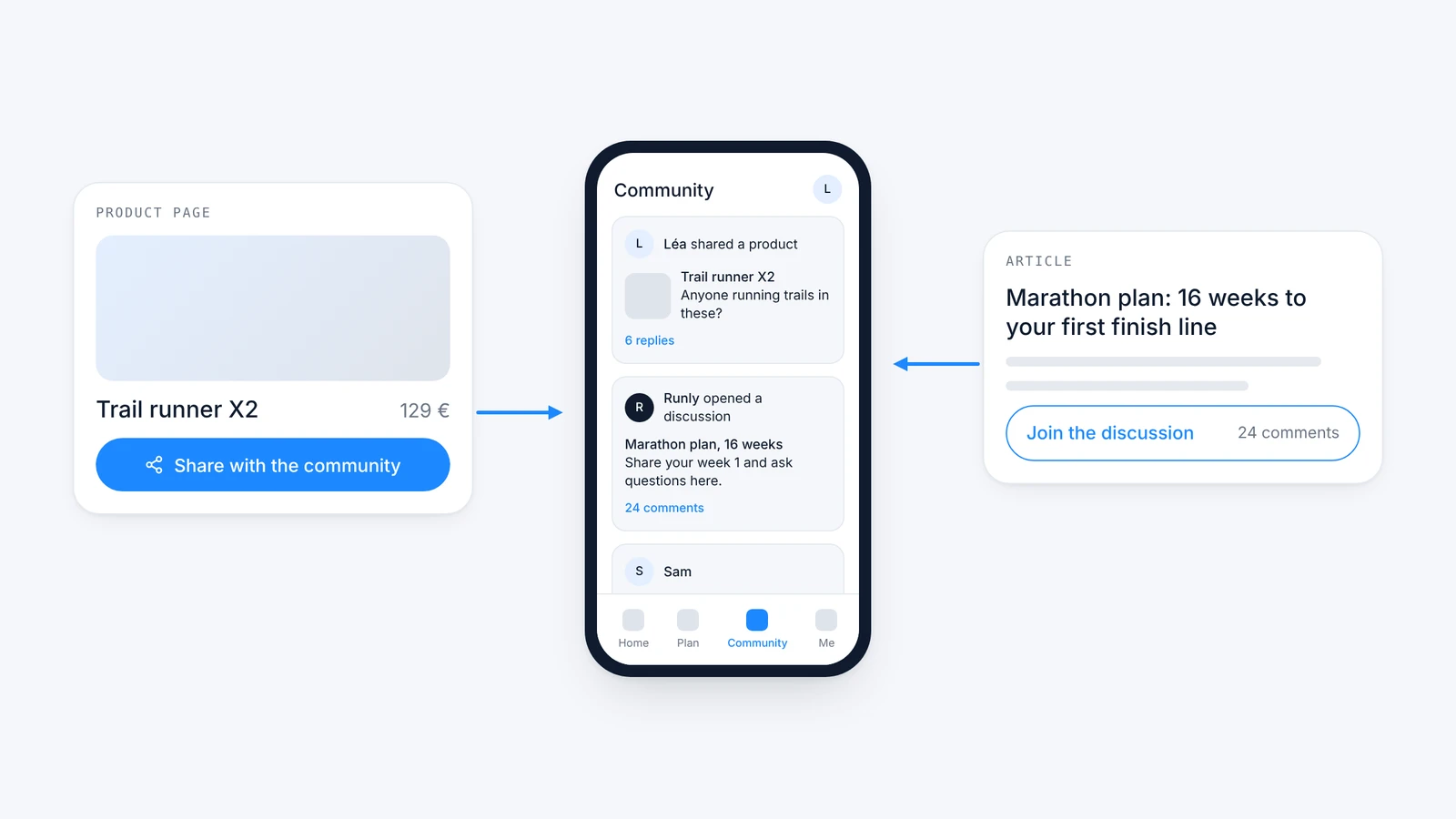
A community tab can work, but the strongest implementations also connect conversation to specific objects and moments. With Octopus Bridge, an app can create a discussion around a product, article, event, achievement, score, or other screen. Users can move from the product into the relevant conversation and back again.
Coin ID uses this model by linking coins in its catalog to dedicated discussion threads. A user who identifies a coin can immediately enter a conversation about its history, rarity, or value. That is a better use of community than asking collectors to start again from a blank composer.
Relevant activity creates the return loop
Replies, reactions, followed groups, and brand posts produce signals that can bring users back. Octopus supports one-to-one push notifications, an unread badge in the app navigation, and administrator broadcasts. The system includes cooldowns because more notifications are not the objective. Useful return visits are.
Hotspot Shield saw daily community users rise from 800 to 8,000 after a notification highlighted a product poll and the app displayed a badge on the community tab. We would not generalize that spike to every app, but the mechanism is clear: the app made relevant community activity visible to users who had not yet discovered it.
Moderation runs before and after publication
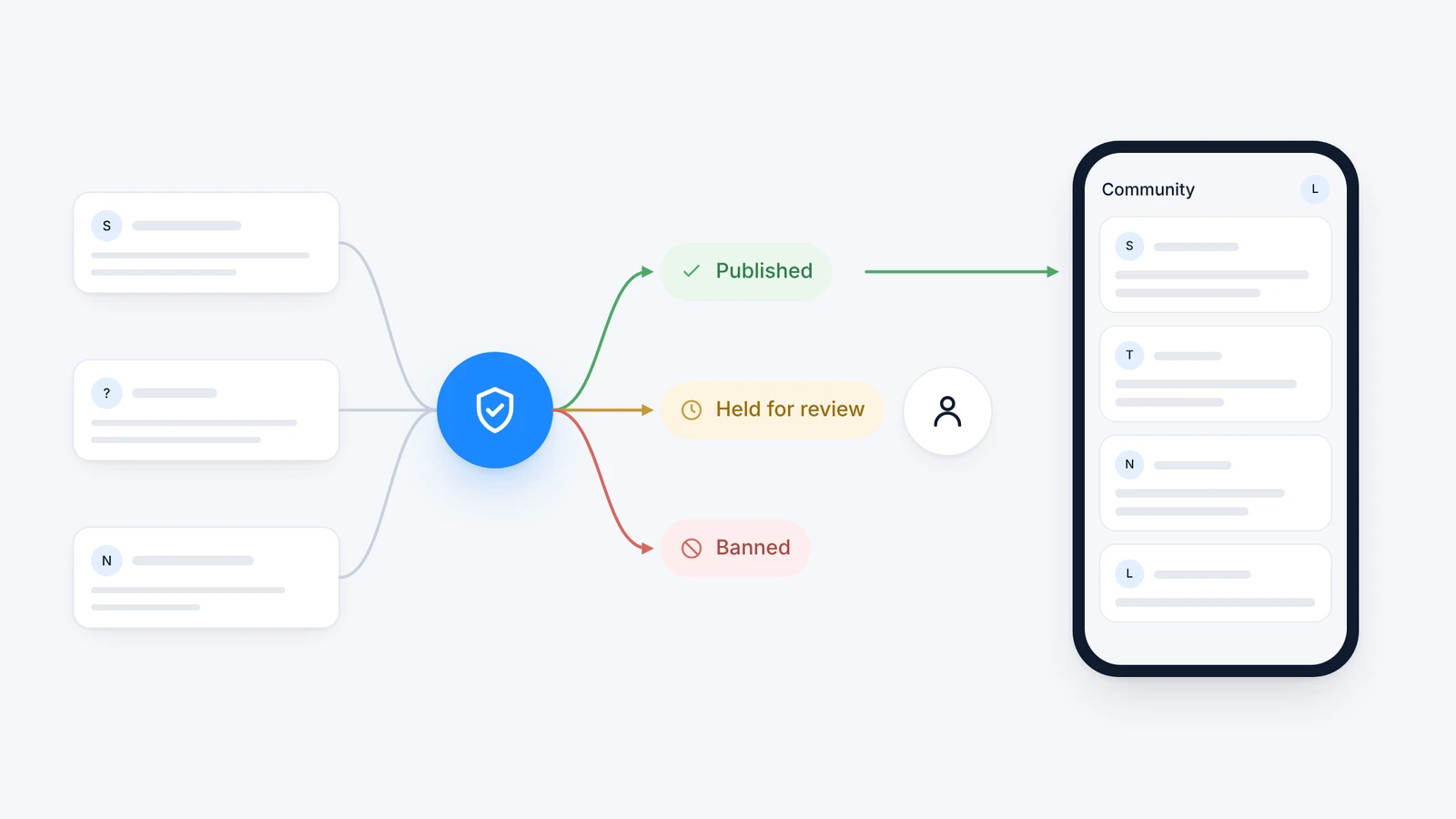
Community adds user-generated content, so safety cannot be a launch-week afterthought. Octopus evaluates content against active policies, takes configured action on clear violations, accepts member reports, and routes sensitive edge cases to human review. Custom rules can address the actual risks of the app rather than applying one generic policy to every audience.
Opla launched with marketplace-specific rules that block external links outside its own domain and filter competitor references. Hotspot Shield uses moderation configured for a multilingual, privacy-sensitive audience. These examples are useful because they show the operating decision behind the feature.
“The minimum is simple: clear rules, moderation live on day one with our default policies, and someone who owns the community. Start with your app's specific risks: spam, competitor links or sensitive topics. The mistake is spending weeks imagining scenarios that never happen. Lean on our experience across communities, and add new rules in minutes when real needs appear. AI handles most decisions, and our human moderators make the calls that need judgment.”
Hélène Quériault, Co-founder and COO, Octopus Community
The feature set we recommend
An in-app community does not need every possible feature on day one. It needs a complete first loop. We recommend launching with the following foundations.
A native entry point and shared identity. Users should reach the community from the app's normal navigation and enter with their existing account.
A clear content structure. Start with a general feed and a small number of groups or topics that reflect real user interests. A long list of empty groups disperses early participation and makes the community look inactive.
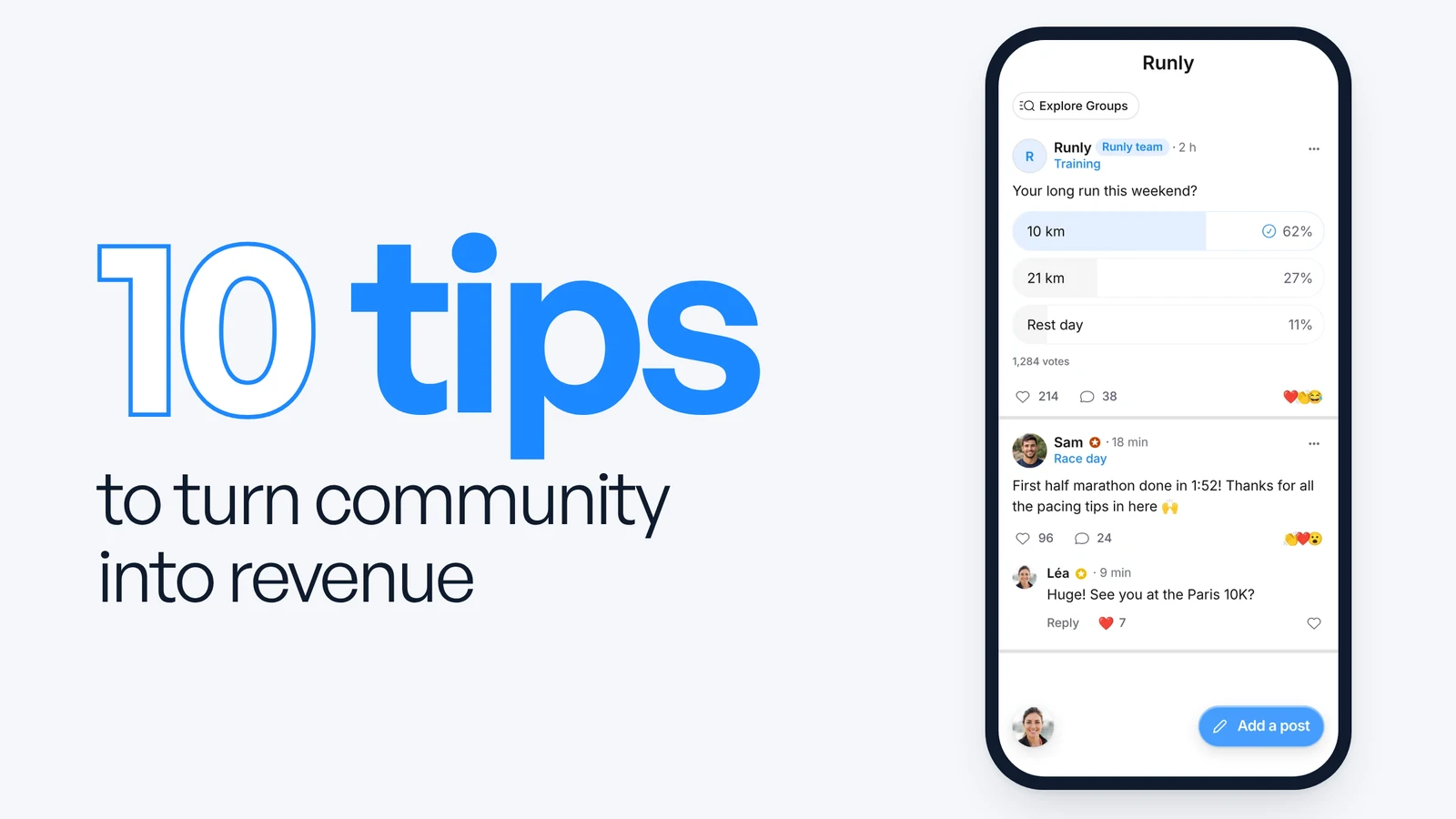
A reason to contribute. Choose formats that suit the product: progress posts for fitness, polls for media, product threads for marketplaces, or help discussions for complex apps. Gamification can reinforce good participation, but it should reward useful actions rather than raw posting volume.
Moderation and escalation. Define rules, automated actions, reporting, human review, and support routing before opening the community.
Discovery and re-engagement. Make the community visible in the product. Use badges and notifications to surface relevant activity, not to manufacture empty sessions.
Measurement. Track discovery, revisit rate, contribution, sessions, retention, support resolution, and business outcomes. When possible, use a holdout or staged rollout to distinguish incremental impact from the fact that highly engaged users are often more likely to visit a community.
Features such as instant translation, premium groups, web access, ads, and advanced sentiment analysis should follow the use case. Coin ID enabled translation across six languages because its collectors were already global. That is a product requirement, not a longer feature checklist.
What we have seen work
The same principles appear across very different apps.
Opla connected community to marketplace behavior. Sellers used the feed to share listings and exchange advice. In the first week, 51% of active users visited the community, more than 3,000 messages were published, and community users generated 2.2 times more app sessions than non-community users.
RunMotion created recurring social rituals. Monthly challenges gave runners an intermediate goal, while peer support made the community useful on ordinary days. The company measured retention against a control group instead of relying only on an engaged-user comparison.
Coin ID linked the social layer to the product object. Each coin can lead to a discussion, translation connects six language groups, and gamification recognizes contributors. Community users open the app three times more often than users without access.
Bankin' used community as an operating channel. The team combined custom moderation for a regulated category, regular discussion notifications, product feedback, and a pinned post during a support spike. The community was not a side campaign. It became part of how the app communicated with users.
In-app community and external platforms
Facebook Groups, Reddit, Discord, and other external communities can still be valuable. They offer reach, familiar behavior, and an existing destination. We do not recommend closing a successful external group simply because an in-app community launches.
The two channels do different jobs. External platforms can support discovery and broad interest. An in-app community is better placed for product-linked discussion, first-party behavior, customer support, and interactions that should lead directly to another action in the app.
An owned community also keeps identity, product behavior, and first-party customer data closer to the app team. That does not make external communities less useful. It gives the branded community a different job: turn customer interaction into product context the team can act on.
RunMotion kept its Facebook group and launched an in-app community alongside it. The in-app space became 15 times more active. The lesson is not that every brand should abandon Facebook. It is that product users often participate more when the conversation is available at the moment it is relevant.
Fitness Camp had active WhatsApp groups before bringing the community into its app. Moving those conversations inside gave the team topic structure, moderation, analytics, and direct access to its own audience. Community members now open the app 10.7 times more often than non-members. That comparison is observational, so we use it as engagement evidence rather than proof of causation.
How to decide whether your app is ready
We recommend moving forward when you can answer four questions clearly.
What will users discuss or do together repeatedly? Sometimes a strong shared interest is enough, especially when users are already organizing elsewhere. If it is not, define the questions, achievements, decisions, or problems that will sustain participation. Octopus's automated community management can schedule posts, reply to members (fully automatically or after your team approves each reply), and promote content that performs well, reducing the work required to get conversations moving.
Where will community connect to the product? Identify the navigation entry, product objects, lifecycle moments, and notifications that make participation feel native.
Who owns the outcome? Octopus can handle most daily moderation, support triage, and community animation, allowing the community to run with minimal client workload. The app team still needs a clear contact for goals, product decisions, and exceptional escalations. That is governance, not a full-time community operation.
How will you measure incremental value? Define the metrics and comparison before launch. Retention is stronger evidence when measured against a control group. Session differences between community and non-community users are useful, but they can also reflect self-selection.
Audience size matters, but participation density matters more. We generally recommend about 1,000 daily active users or at least 50,000 monthly active users. A smaller niche can still work when members share a strong recurring need, as Unchaind shows. Treat those figures as planning guidance from our experience, not a universal law.
Build the infrastructure or use a community SDK
Building community in-house gives a team complete architectural control. It also means owning feed performance, profiles, notifications, moderation, reporting, administration, analytics, platform updates, compliance, and the less glamorous work that appears after launch.
A community SDK packages those capabilities so the product team can focus on where community belongs in the app. Octopus provides native SDKs for iOS, Android, Flutter, React Native, Web, and Unity. The core experience typically requires one to three days of integration work, although authentication, event tracking, release processes, and optional features still affect the complete timeline.
Our recommendation is straightforward: do not build social infrastructure in-house unless community is the product itself, as it is for a social media app. Feeds, profiles, notifications, moderation, administration, analytics, compliance, and platform maintenance consume far more engineering and operating time than the first release suggests. Use an SDK and keep your team focused on the experience that is specific to your users.
Bring community into the product
An in-app community works when it makes the app more useful because other users are there. Start with one participation loop connected to the product, launch it with a complete safety and measurement plan, and expand after you can see what users value.
Octopus Community provides the native experience, moderation, engagement tools, support workflows, translation, and insight layer behind that launch. If you want to see how the SDK would fit your app, book a demo with our team.
Frequently asked questions
How many users do you need for an in-app community?
There is no universal threshold. We generally use about 1,000 daily active users or at least 50,000 monthly active users as planning guidance, but a smaller niche app can work when members share a strong recurring need. Participation density and a repeatable reason to interact matter more than headline audience size.
How does an in-app community improve retention?
It creates reasons to return that come from other users, including replies, peer help, shared challenges, product discussions, and group activity. Over time, repeated useful interactions can strengthen loyalty to the product. The strongest evidence comes from controlled or staged measurement rather than comparing self-selected community users alone.
Which features should an in-app community include first?
Start with shared identity and several native entry points: a main community feed plus contextual Bridges from relevant screens, products, or events. Add a clear content structure, relevant re-engagement, and measurement. Moderation and reporting are included for every Octopus client rather than optional add-ons. Translation, gamification, web access, premium groups, or monetization should follow the use case.
How is an in-app community different from Discord or Facebook Groups?
An in-app community can connect discussion to product identity, behavior, content, and actions. You own the community data and have a direct line to people you know are actual product users. External platforms provide their own destination and audience. Many brands use both for different parts of the customer journey.
How much work does an in-app community require?
With Octopus, the core technical integration typically takes one to three days of development. After launch, Octopus handles most moderation, support triage, and engagement operations. The client team provides goals, product context, and occasional decisions or escalations, but it does not need to run a full community operation.
Should we build an in-app community in-house?
We almost never recommend building an in-app community stack in-house unless community itself is the product. Doing it properly takes substantial engineering and operating resources, and the work continues after launch. We have seen clients try to build internally and later return to Octopus. Use an SDK when speed, proven operations, and keeping engineering focused on the core product matter.